Wastewater companies sit where regulation, industrial production and water security meet. They can sell equipment, run treatment assets, provide long-term operations services, or turn treated wastewater into a reliable industrial input. That range creates opportunity, but it also makes the sector easy to misunderstand.
For private investors, the right question is not simply whether wastewater demand is growing. It is whether a company can convert a clear customer problem into repeatable revenue, acceptable margins and defensible operating evidence. The Water Investment Network market guide provides the wider sector context. This article focuses on how to assess the companies within it.
The strongest wastewater companies usually have five traits. They solve a costly or regulated customer problem, prove treatment performance in real operating conditions, sell through a clear contract structure, understand their unit economics and have a credible path from one site to many.
The weakest cases often rely on a broad market story. They may have impressive pilot results but no repeatable sales process, or a technically strong product with uncertain customer ownership. Some also confuse a large infrastructure need with an investable company. Investors still need to test pricing, delivery risk, working capital, service capacity and the quality of the counterparty.
Public and private capital can both play a role in water and wastewater infrastructure. The World Bank stresses that clear pricing, suitable delivery models and bankable investments are needed to mobilise private participation in reuse. That distinction matters when comparing wastewater companies with different business models.
Why wastewater companies are not one market
“Wastewater” describes a flow of used water, not a single product category. The flow may come from a factory, a food processor, a mine, a municipal network, a data centre or another industrial site. Its chemistry, volume, discharge rules and reuse potential can differ sharply.
That variation creates several commercial markets. A company may sell a treatment system to a customer, operate a plant under contract, recover water or materials, or provide specialist monitoring and maintenance. Each route changes the sales cycle, capital requirement, margin profile and risk allocation.
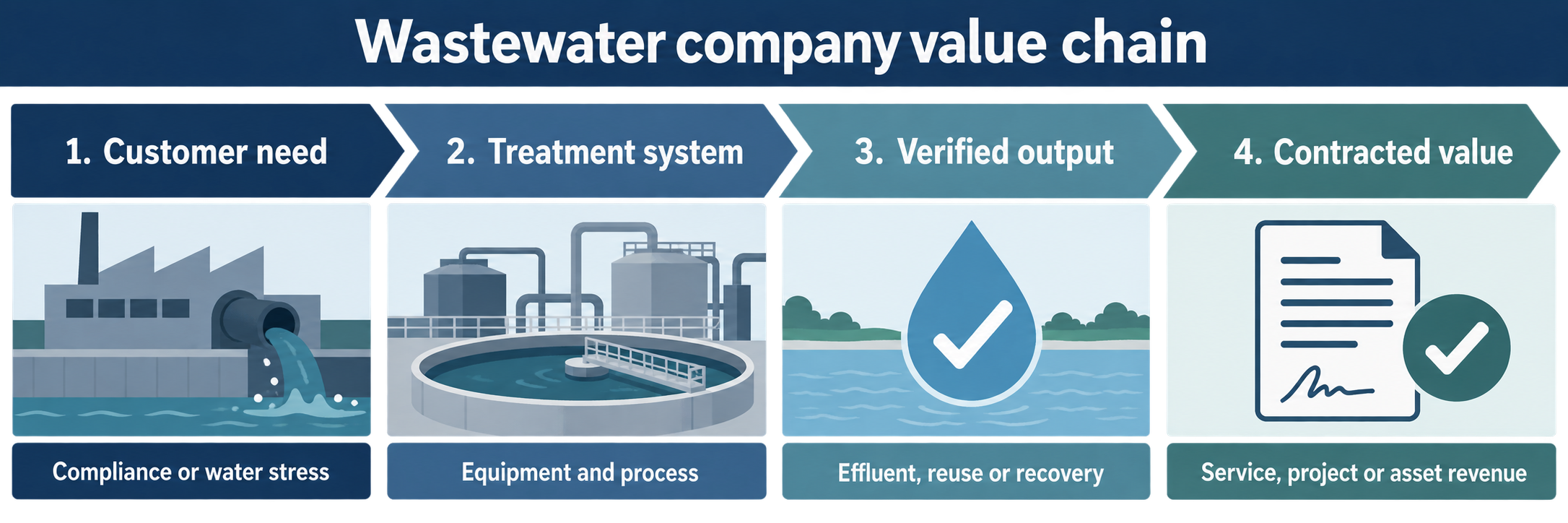
The value chain above is a useful first filter. A customer need is only the start. The investment case becomes stronger when the treatment system produces a verified output that a customer pays for under a clear agreement. If one of those links is weak, a large addressable market may not translate into company revenue. For more background on the network’s approach, visit the Water Investment Network homepage.
What is driving demand for wastewater companies?
Demand usually comes from a mix of compliance, operating continuity, freshwater constraints and customer economics. A factory may need to meet discharge limits. An industrial site may need a more reliable process-water supply. A utility may need to upgrade ageing treatment assets or manage emerging pollutants.
The European Environment Agency reports that most EU environmental protection expenditure is directed towards waste management and wastewater treatment. It also estimates that the EU needs additional environmental investment through 2030. These figures show the scale of spending pressure, but they do not prove that every wastewater company will capture it. Investors must still identify the buyer, procurement route and contract terms.
The European Investment Bank describes a similar shift in the EU water sector. After major infrastructure build-out, more work is moving towards operation, maintenance, upgrading, renovation and the management of emerging pollutants. This can support companies with proven service capability, but it may favour dependable operators over untested equipment alone.
Reuse creates another demand channel. The World Bank says the business case for reuse is strongest when wastewater is close to the point of use, such as in urban centres and industrial parks. That is commercially relevant because shorter distances can reduce distribution costs and make the customer benefit easier to measure.
Which types of wastewater companies can investors back?
Investors should classify the company before judging growth. “Waste water treatment companies” can describe very different businesses. A company that sells a modular plant does not carry the same risk as a company that owns and operates a treatment asset.
Searchers may also use the broad phrase “water wastewater companies” when they are comparing suppliers. That label is too wide for diligence, so the investor should identify the exact treatment problem, buyer and revenue model behind each business.
- Equipment and systems providers: These companies design or manufacture treatment units, membranes, biological systems, dosing equipment or packaged plants. Revenue may be project-based, with exposure to engineering, procurement and installation risk.
- Operations and maintenance providers: These businesses run plants, maintain equipment and monitor performance. Their value depends on service delivery, contract renewal, labour capacity and the ability to protect customer uptime.
- Reuse and resource-recovery companies: These companies treat wastewater so that water, nutrients, energy or another output can be used again. The business case depends on quality standards, the offtaker, logistics and the price of the recovered output.
- Specialist treatment and monitoring providers: These businesses focus on a contaminant, process step, sensor or control layer. They can be defensible when the problem is difficult, but they still need evidence that the customer will pay for the improvement.
Some companies combine these categories. That can improve customer value, but it can also make financial reporting harder to read. Ask management to separate product revenue, installation revenue, recurring service revenue and any project development income.
How do wastewater companies make money?
Revenue quality depends on what the customer buys and who carries the operating risk. A one-off equipment sale may produce strong revenue in a delivery year, but it can also create uneven working capital and limited visibility after commissioning. A service contract may be steadier, but it needs enough margin to cover staff, spares, travel, energy support and performance obligations.
Water reuse services can look attractive when an industrial customer has a clear need for treated water. The World Bank identifies clear pricing signals, regulation, suitable delivery models and bankable financing as important conditions for scaling reuse. Investors should therefore test the complete chain, from wastewater supply through treatment to the contracted offtake.
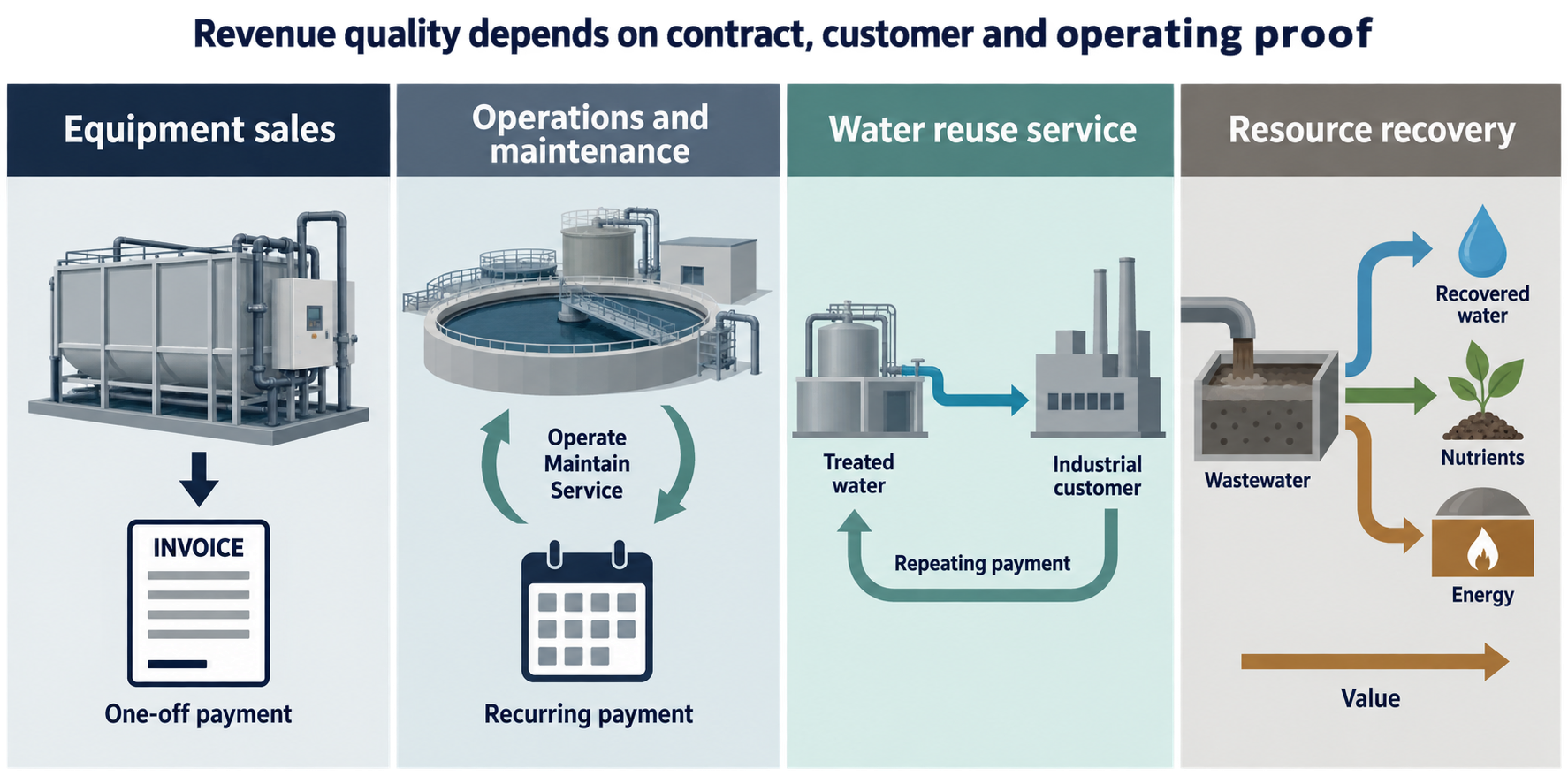
The revenue model diagram is a practical way to compare businesses. It does not rank one model as universally better. It highlights the questions that matter: is payment one-off or recurring, is the customer contract durable, is performance measurable and can the company deliver without absorbing uncontrolled cost?
What should investors test in the customer base?
Customer demand should be specific enough to support a budget. “Water is important” is not a purchasing reason. A stronger case identifies the discharge requirement, production risk, freshwater cost, site expansion, reuse target or maintenance problem that creates a buying decision.
For each major customer, examine the economic owner of the problem. The plant manager may feel the operational pain, while procurement controls the contract and the finance team approves the spend. A wastewater company with a good technical contact but no budget access may face a long and uncertain sales cycle.
Useful customer questions include:
- What event made the project a priority?
- Does the customer pay for compliance, avoided downtime, fresh-water substitution, treatment capacity or a recovered output?
- Who owns the treated water, recovered material or compliance certificate?
- How long is the contract, and what happens when performance falls below the agreed standard?
- Can the customer renew, expand or replicate the solution at another site?
A concentration review is also essential. A small number of industrial customers can make a company look mature while leaving it exposed to one procurement decision. Check customer concentration by revenue, gross profit, contracted backlog and unpaid receivables.
How should investors judge unit economics?
Wastewater unit economics are site-specific. The main cost drivers can include energy, chemicals, membranes, labour, sludge handling, transport, maintenance, compliance testing and plant downtime. The correct measure depends on the business model, but investors should understand the cost to treat a defined flow to a defined quality at a defined site.
For equipment companies, ask whether gross margin includes commissioning support, warranty work and redesign. For operators, ask how service margin changes when a plant receives a more variable wastewater stream. For reuse businesses, test the cost of producing water against the customer’s alternative supply, including connection, storage and reliability.
Do not accept a margin story based only on a pilot. A pilot may use a favourable feedstock, extra technical attention or grant-funded labour. Compare pilot performance with the proposed commercial configuration. Then test whether the company has enough installation, service and monitoring capacity to protect that margin at scale.
Can a wastewater company scale beyond its first sites?
Scale in water is rarely just a software question. A company may need site surveys, permissions, engineering changes, skilled installation, commissioning, operator training, spare parts and long-term monitoring. Each new site can create value, but it can also add complexity.
The World Bank’s reuse work stresses programmatic approaches, clear pricing and appropriate delivery models. For investors, that means looking for a repeatable deployment method. A company should be able to explain which parts are standard, which parts need site-specific design and which risks are passed to a contractor, customer or financing partner.
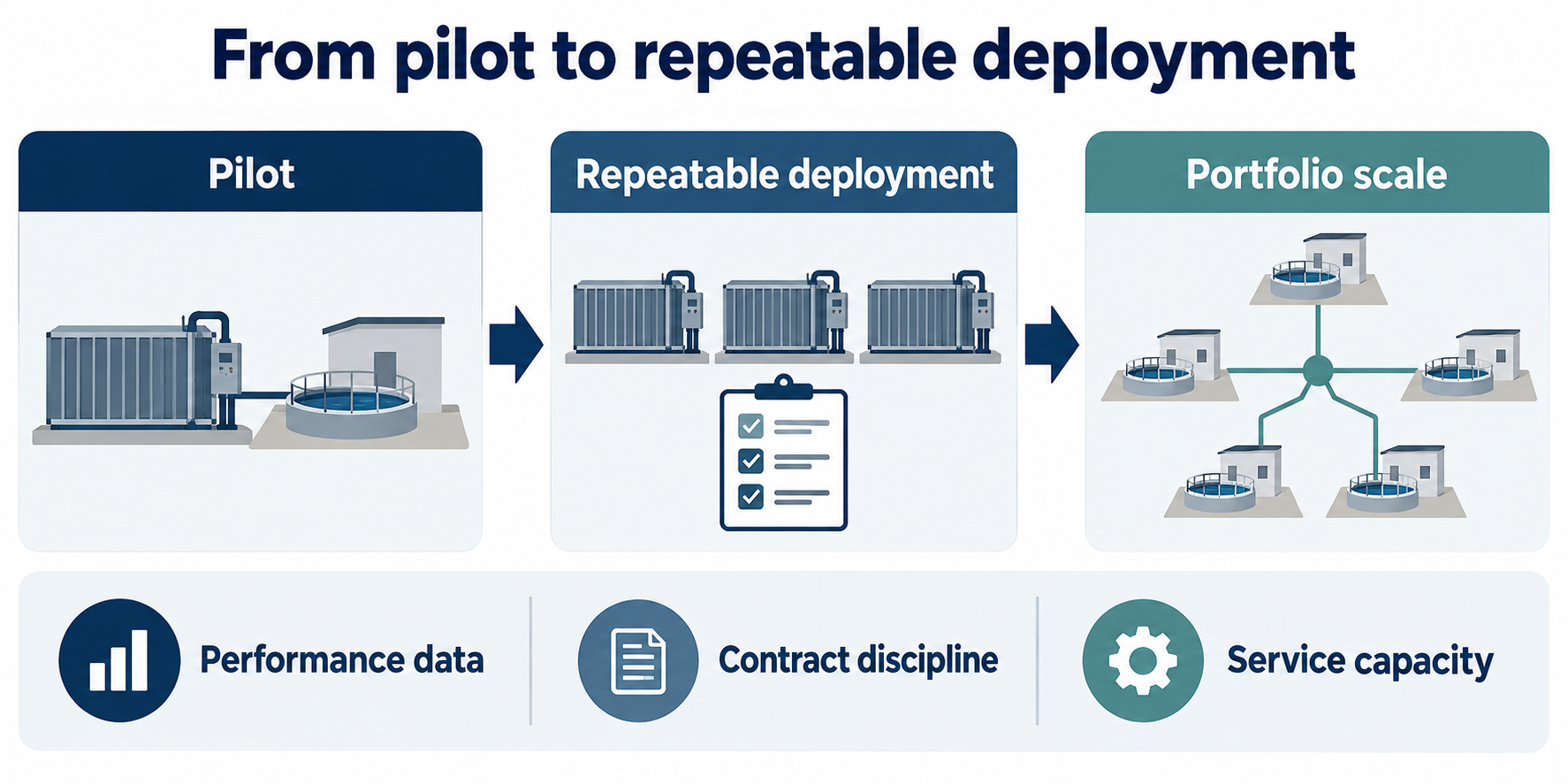
Repeatability is not the same as a large pipeline. Review the evidence behind each stage. A signed memorandum is not the same as revenue. A successful pilot is not the same as a commissioned commercial plant. A second site is useful evidence only if the company can show what was repeated and what changed.
What regulation and execution risks matter most?
Regulation can create demand, but it can also slow delivery. Treatment requirements may vary by location, receiving environment, industrial process and permit. A company selling into the UK, Europe or GCC must show that its claims match the relevant market and that it understands who holds the compliance obligation.
The EIB points to continuing needs around upgrades, emerging pollutants and water security. Those themes can support investment, but they do not remove procurement, permitting or performance risk. The investor should distinguish a legal requirement from a policy ambition and a policy ambition from a funded project.
The UK government’s 2026 water white paper places attracting investment, clearer regulation, wastewater treatment and water reuse within its proposed reform direction. For a company selling into the UK, this is useful context, not a guarantee of procurement or company revenue. The opportunity still depends on the route from policy to funded customer work.
Key execution risks include:
- Performance risk: the system does not meet the contracted output when feed conditions change.
- Construction risk: site work, integration or commissioning takes longer or costs more than expected.
- Counterparty risk: the customer delays payment, changes ownership or does not renew the contract.
- Regulatory risk: the required permit, discharge standard or reuse approval takes longer than planned.
- Service risk: the company cannot recruit, train or retain enough operating staff to support a growing estate.
Private investors should also examine liability. If a treatment failure interrupts production or causes a compliance breach, who pays for remediation? Contract caps, insurance, warranties and performance guarantees should be reviewed with suitable legal and technical advisers.
What is a practical wastewater company diligence scorecard?
A short scorecard can prevent a market narrative from replacing evidence. The five areas below should be tested together. A company that scores well technically but poorly on contracts may still be difficult to underwrite.
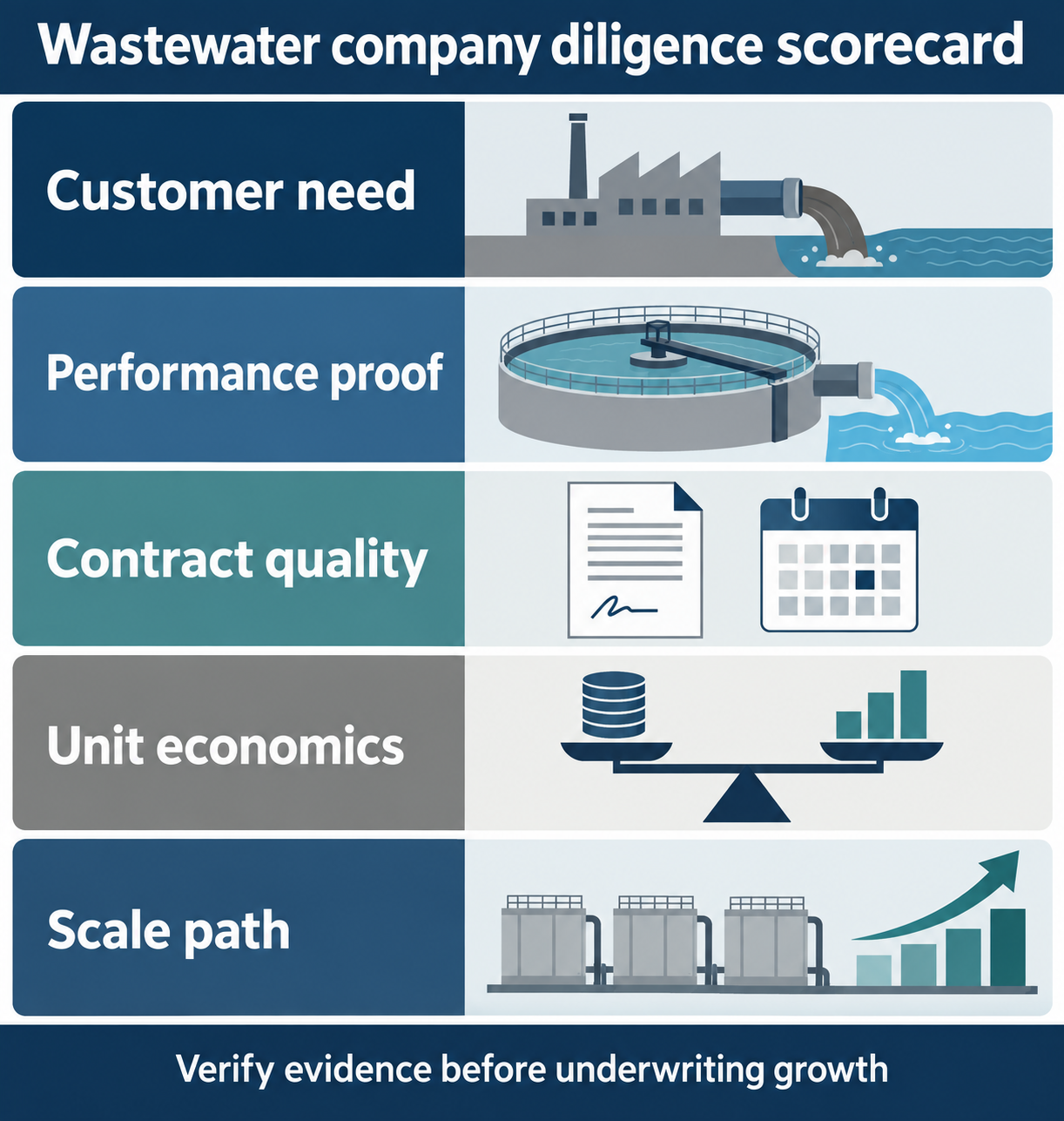
- Customer need: Is there a clear operational, compliance or water-supply problem with an approved budget?
- Performance proof: Does independent or customer-verified evidence show the required treatment outcome under realistic conditions?
- Contract quality: Are pricing, term, renewal, service levels, payment timing and liability clear?
- Unit economics: Can the company explain gross margin, working capital, energy exposure and maintenance cost by project or site?
- Scale path: Can the company repeat delivery without relying on one founder, one supplier or one unusual customer site?
The scorecard should be backed by documents, not management language alone. Ask for customer contracts, commissioning records, performance data, maintenance logs, warranty claims, supplier terms, aged receivables and a bridge from pipeline to contracted revenue.
Where can wastewater companies fit in a private portfolio?
Wastewater companies may offer exposure to essential infrastructure, industrial efficiency and circular water systems. Their risk can differ from a utility or a public-market water fund because the investor may be backing a technology provider, a service business or a private asset platform.
Portfolio construction still needs discipline. Consider customer and geography concentration, exposure to construction cycles, reliance on public procurement, debt at the project level and sensitivity to energy prices. A company serving several industrial end markets may diversify demand, but it can also face more complex sales and compliance requirements.
Impact should be measured alongside commercial performance. Possible evidence may include treated volume, pollutant reduction, freshwater substitution, energy use, recovery rates or compliance performance. The metric should be defined, repeatable and linked to the operating site. It should not be presented as a return forecast or as a substitute for financial diligence.
Investors who want to compare direct opportunities can review the Water Investment Network portfolio. The role of this article is to frame questions for diligence. It is not regulated financial advice, and it does not promise performance or returns.
Frequently asked questions
What do wastewater companies do?
Wastewater companies design, supply, operate or maintain systems that treat used water. Some also provide reuse, monitoring or resource-recovery services for industrial and municipal customers.
Are wastewater companies good investments?
Some may have attractive characteristics, but suitability depends on customer demand, contracts, performance evidence, unit economics, regulation and valuation. A large market need alone is not enough.
How do wastewater treatment plant companies earn revenue?
They may earn from equipment sales, engineering and installation, operations and maintenance contracts, treatment fees, reuse services or recovered outputs. The risk profile changes with each model.
What should investors check before backing a wastewater company?
Check the customer problem, treatment results, contract terms, cost base, working capital, compliance obligations, supplier dependence and ability to repeat delivery across sites.
How can I assess private water-technology opportunities?
Start with evidence-led commercial and technical diligence. Investors who meet the network’s criteria can learn how to join the Water Investment Network and review relevant opportunities.
Sources
- International Finance Corporation, PPP Sector Factsheet: Water
- World Bank, Scaling Water Reuse: A Tipping Point for Municipal and Industrial Use
- European Investment Bank, Water Sector Lending Orientation
- European Environment Agency, Environmental Protection Expenditure
- GOV.UK, A new vision for water