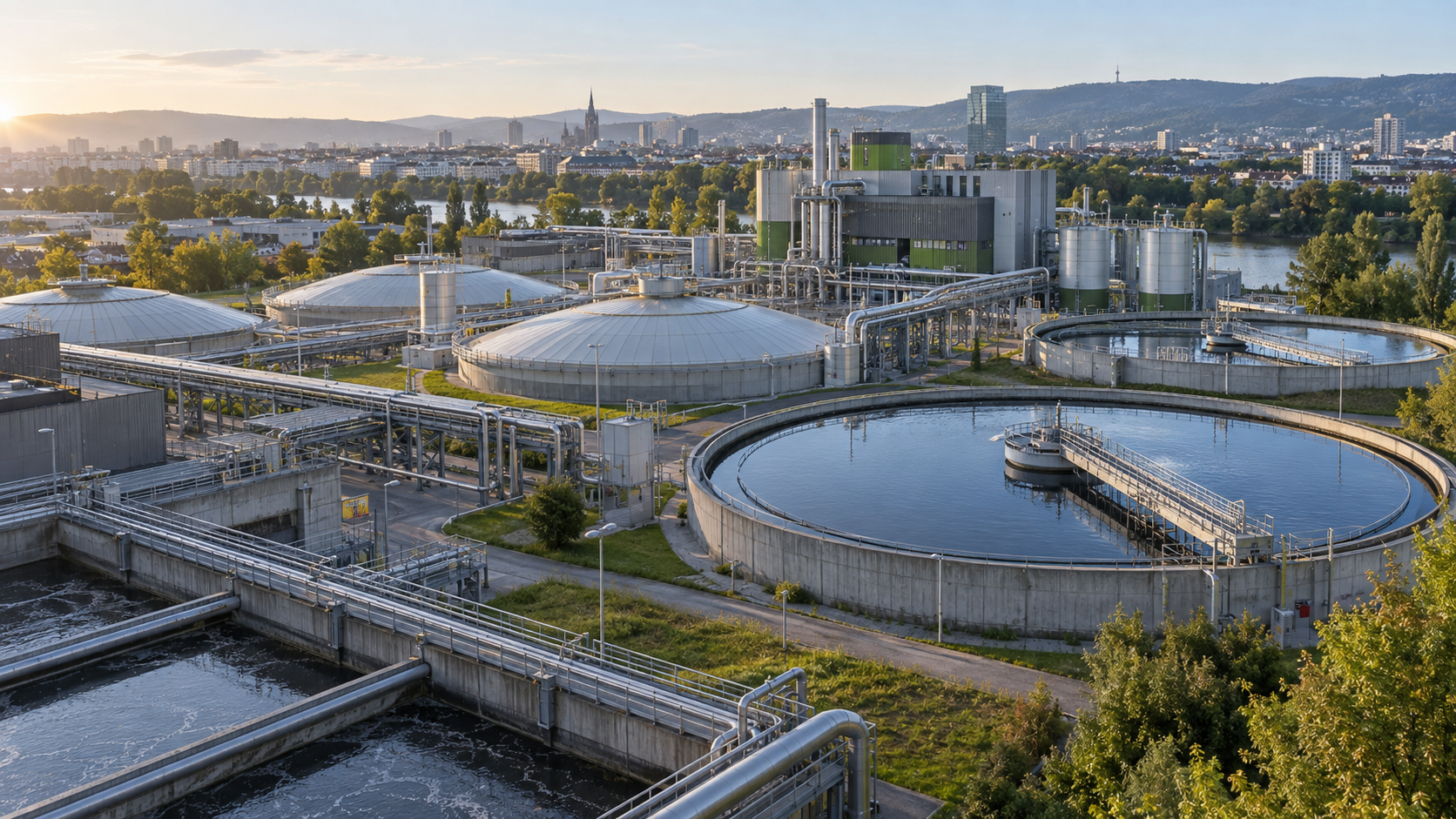
The wastewater industry sits where public health, industrial production and water security meet. That gives it durable demand, but it does not make every wastewater business investable. Buyers, contracts, assets and risks differ across the value chain.
For family offices and sophisticated private-market investors, the useful question is not whether wastewater matters. It is which customer problem creates a budget, which company captures revenue, and whether the model can scale without consuming more capital than it creates.
This guide maps the wastewater treatment industry for investors. It covers customer demand, private-company segments, revenue models, regulation, reuse, financing, operating scale and diligence. It does not provide regulated financial advice or promise any investment outcome.
Whether a report calls it the wastewater industry or the waste water industry, the commercial test remains the same: who pays, why now and what evidence supports repeatable delivery?
Water Investment Network connects eligible investors with selected private water-technology opportunities. Its water technology market guide sets out the wider market map. This article focuses more narrowly on wastewater and the evidence that can turn sector need into a credible company case.
Wastewater is a value chain, not a single market
Wastewater begins with a waste stream, but the commercial chain does not end at treatment. Collection, process performance, testing, discharge, reuse and resource recovery each create different requirements for buyers and suppliers.
A utility may buy a long-life treatment asset. A factory may need a modular system that protects production or reduces disposal cost. A technology supplier may sell equipment, components, controls or specialist services to either customer. These are related markets, not interchangeable ones.
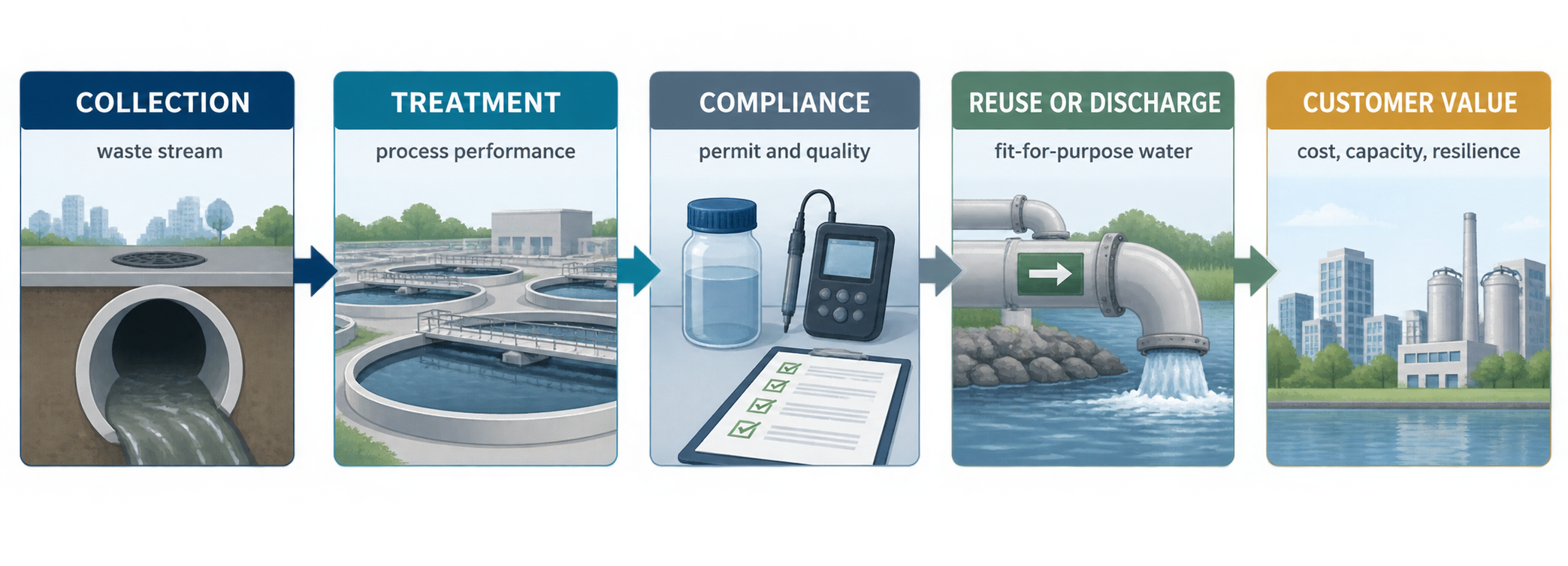
The European Investment Bank describes the sector as moving beyond new infrastructure alone. Operating, maintaining, upgrading and renovating existing systems are becoming more important, alongside emerging pollutants and water-security needs. Its water-sector lending orientation also distinguishes the investment priorities of water and wastewater management from the wider water cycle.
That distinction matters for investors. A company that supplies a repeatable process to many sites may have a different growth path from an owner of one regulated asset. A business can benefit from the same demand driver while carrying very different working-capital, procurement and execution risks.
Find the customer problem that releases a budget
Wastewater creates a budget when the cost of inaction is visible. That cost may be a permit breach, a production stoppage, a disposal bill, a water-supply constraint, an asset failure or a loss of customer trust.
Municipal buyers often work through long planning and procurement cycles. Their decisions can depend on funding allowances, environmental outcomes, service reliability and whole-life value. Industrial buyers may move faster when treatment affects throughput, product quality, site expansion or operating cost.
Investors should ask five questions before accepting a large market narrative:
- Who owns the wastewater problem and the budget?
- What event moves the buyer from interest to approval?
- What alternative can the customer choose?
- How is value measured after commissioning?
- Does the same buying reason exist at the next site?
The European Environment Agency reports that most EU environmental protection expenditure is spent on waste management and wastewater treatment. It also warns that the wider funding gap for environmental objectives remains substantial. The EEA indicator shows why expenditure is useful demand context, but not proof that one supplier will win a contract or earn an attractive margin.
Map the private segments inside the wastewater industry
The private wastewater market includes more than plant owners. A useful map separates companies by what they sell and where they carry risk.
- Process and equipment suppliers: treatment modules, pumps, membranes, aeration, separation, dosing and control equipment.
- Specialist technology companies: processes that target difficult contaminants, recovery, energy use or space constraints.
- Monitoring and data providers: sensors, laboratory services, controls and software that help customers act on water-quality or asset data.
- Operators and service companies: maintenance, performance contracts, compliance support and outsourced operation.
- Asset and project businesses: companies that finance, build or operate treatment and reuse capacity for a defined customer or catchment.
The same company can sit in more than one segment. That can increase customer value, but it can also hide the true source of margin. Investors should separate product margin, installation margin, service margin and asset-level cash flow.
The phrase water and wastewater industry therefore covers several routes to market. A treatment component may sell through an integrator. A plant operator may depend on a concession or availability payment. A monitoring company may need recurring software usage before its economics look digital. Segment labels should never replace a customer and contract review.
Compare revenue models before growth rates
Wastewater companies can show similar revenue growth while creating very different investor outcomes. The key questions are who funds the asset, when cash arrives, how much working capital is required and whether revenue repeats.
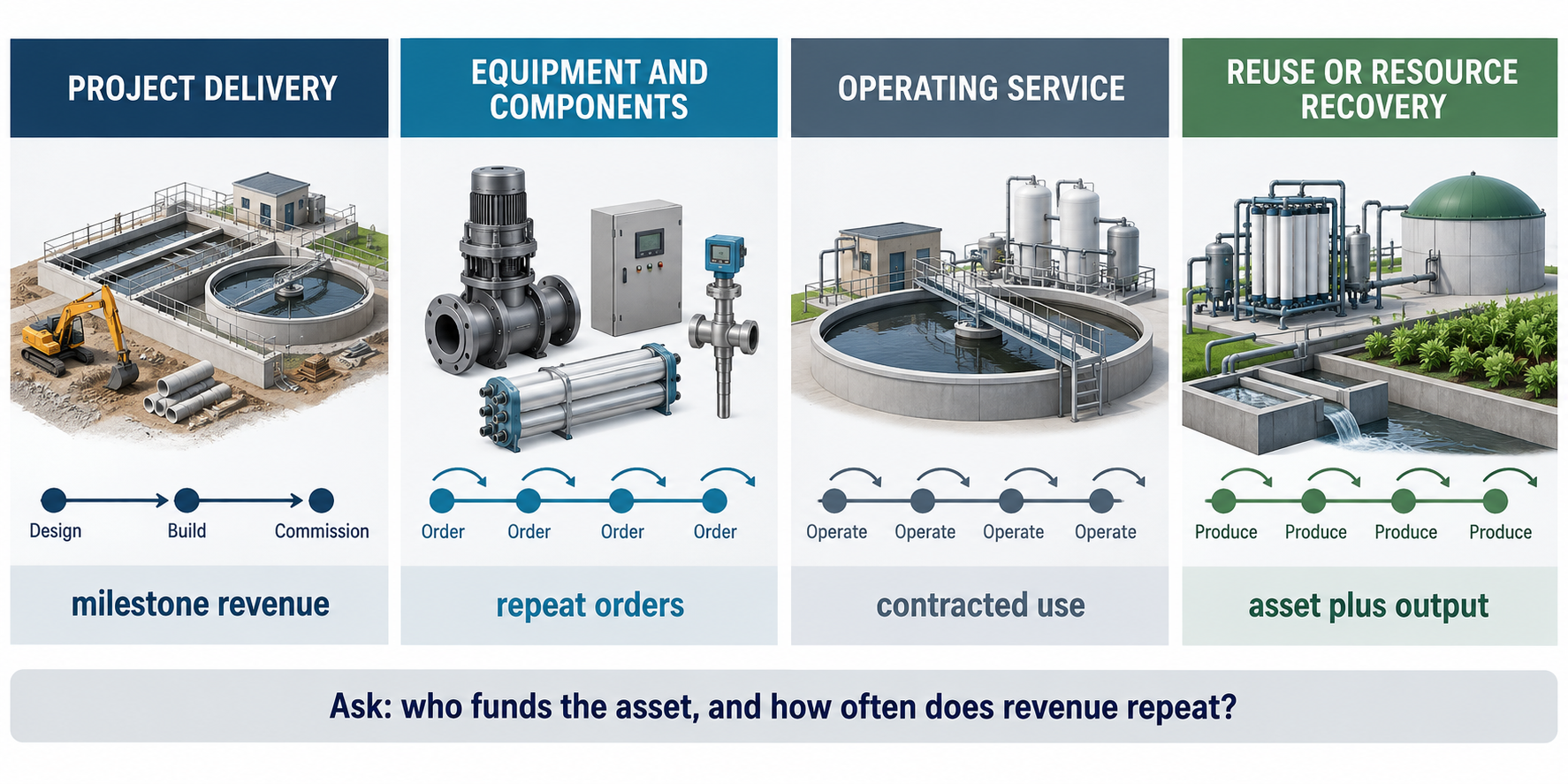
Project delivery can produce large orders, but revenue may depend on milestones, commissioning and customer acceptance. Equipment and component businesses can benefit from repeat orders, yet they may face price pressure, inventory needs and channel dependence.
Operating-service models can create contracted use and closer customer relationships. They also carry staffing, uptime, maintenance and performance obligations. Reuse or resource-recovery businesses may combine an installed asset with an output such as treated water, recovered material or energy. That can deepen the moat, but it can also increase capital intensity and operating complexity.
Investors should test gross margin after warranty and service costs, debtor days, cash conversion, renewal rates, customer concentration and the funding source for each new site. A recurring label is not enough. Contract length, termination rights, price adjustment, performance tests and renewal behaviour determine revenue quality.
Use regulation and public investment as market infrastructure
Regulation can create demand for wastewater upgrades, monitoring and reporting. It does not guarantee a supplier order. The commercial pathway still runs through permits, procurement, technical acceptance, funding, installation and operating performance.
In the UK, the government’s 2026 water white paper describes a long-term reform programme for water security, investment and environmental performance. It includes significant planned expenditure on storm overflows and wastewater treatment works in England. The white paper also stresses the need for clearer planning and more stable conditions for long-term investors.
European markets have their own national procurement, permitting and funding structures. The EIB identifies a continuing need to operate, maintain, upgrade and renovate water infrastructure, while the EEA reports expenditure across wastewater and wider environmental protection. These sources support a demand thesis, not a forecast for any individual company.
For a private wastewater business, diligence should connect the rule to the buyer. What obligation applies? Which party must act? Is the proposed solution accepted by the regulator and the customer? Does the company have evidence that the budget is approved, rather than merely discussed?
Test reuse and resource recovery on real economics
Wastewater can become a supply of fit-for-purpose water, energy or recovered materials. The opportunity is strongest when the waste stream is close to a customer that can use the output and when quality requirements are clear.
The World Bank’s Scaling Water Reuse report says cities and industries generate nearly 1 billion cubic metres of used water each day. It highlights the role of enabling regulation, programme-scale investment, clear pricing signals and bankable delivery models in expanding reuse.
Investors should still ask what happens between a technical result and a paying contract. The project may need pretreatment, energy, storage, quality testing, a backup supply, offtake commitments and a plan for concentrate or residuals. Each item affects capital expenditure, operating cost, uptime and liability.
Resource recovery can add value, but it can also add exposure to commodity prices, buyer specifications and additional process steps. The investment case should show the base case without optimistic recovery revenue, then explain what evidence supports any upside.
Build bankability around customer, contract and capital
Bankability means that a project or company has enough evidence for a financier or investor to assess risk and commit capital. It is not the same as technical feasibility. A working pilot may still lack a creditworthy customer, a durable contract or a viable funding structure.
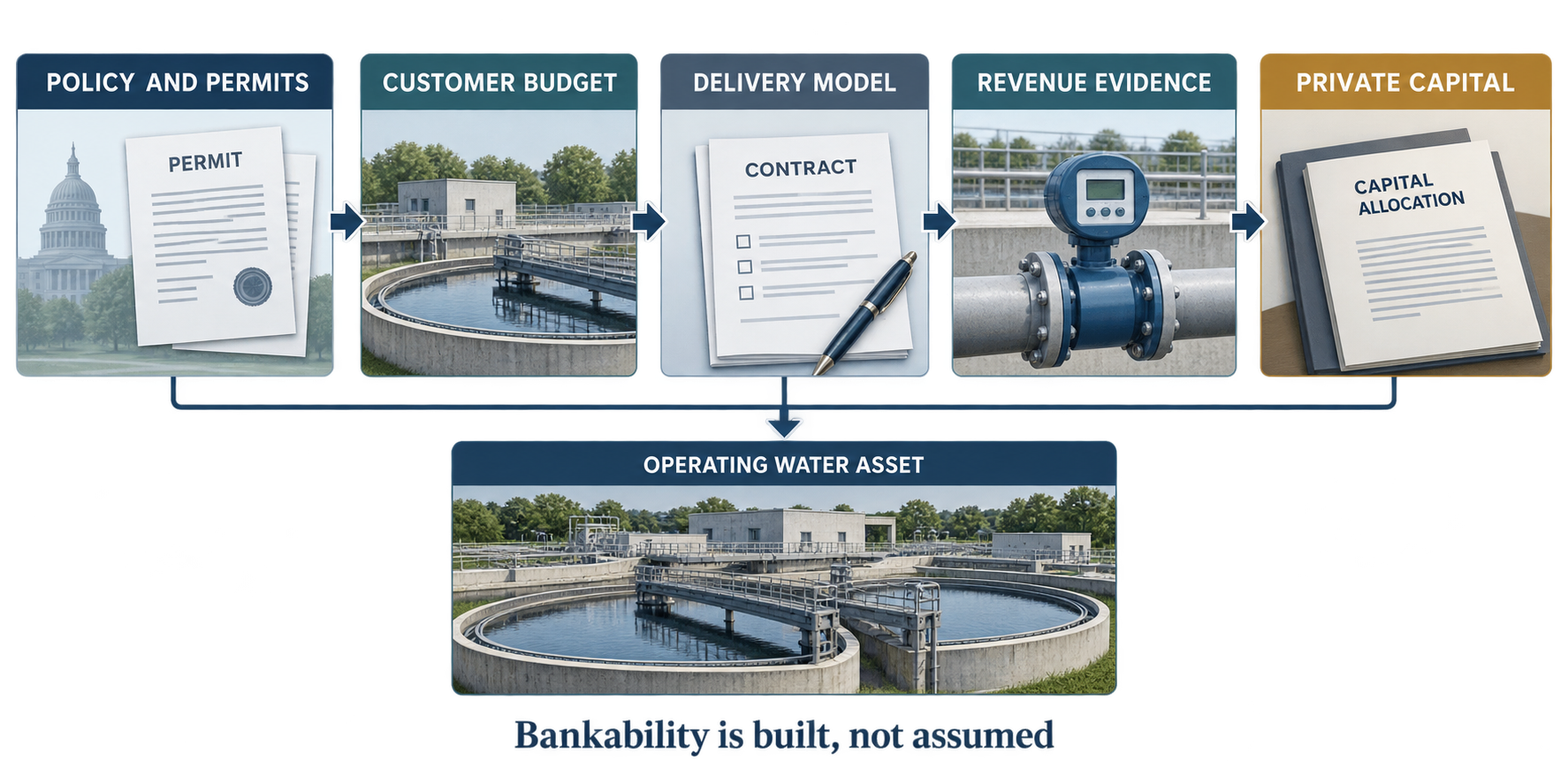
Finance structure matters as much as the amount of capital. Public-private partnership experience shows how contracts can combine private capital, operating expertise and technology, but it also shows why contractual strength and local delivery capacity matter. The IFC water PPP factsheet gives examples of wastewater and water projects where the delivery model was part of the investment case.
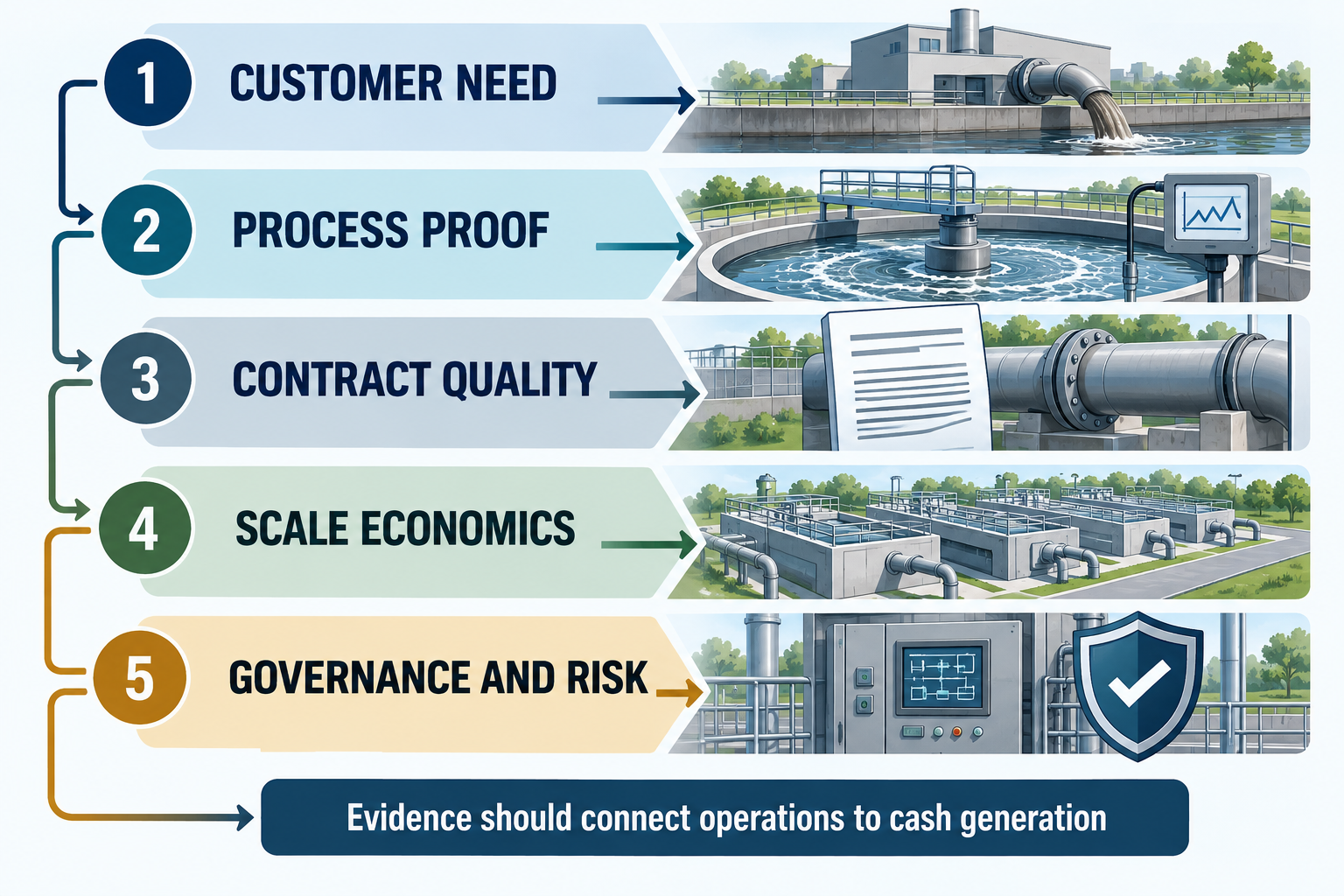
For a wastewater company, the evidence chain should include the customer problem, process performance, contract terms, delivery model and capital plan. Investors need to know who owns the asset during construction, who carries performance risk, how delays are funded and what happens if the customer changes its requirements.
Family offices and other private investors can bring patient capital to businesses that need time to prove repeatability. Patience does not remove the need for milestones. It makes clear milestones, reporting and capital-allocation discipline even more important.
Measure scalability in operations and unit economics
A wastewater product scales only if it can be delivered repeatedly under real site conditions. The technical core may be standard, while the installation, feed water, permits, controls and customer workflow vary by location.
Investors should examine the number of engineering hours per deployment, commissioning time, supplier concentration, field-service travel, spare-parts needs and warranty claims. They should compare the first commercial site with later sites rather than relying on a single successful demonstration.
Unit economics should include the full cost to win and serve a customer. That means sales-cycle length, bid costs, testing, integration, training, maintenance, energy, chemicals, insurance and working capital. A high gross margin before these costs may not translate into cash generation.
The practical scale test is simple: can the company add sites without adding risk at the same rate? Modular design, repeatable documentation, trained partners and remote monitoring can help. They are useful only when the company can show lower delivery friction and stable performance across customers.
Keep impact evidence separate from commercial evidence
Wastewater businesses can deliver environmental value and still fail commercially. They can also earn revenue while producing weak or poorly measured impact. Investors should keep two evidence ledgers and test where they meet.
The impact ledger may include treated volume, reuse volume, pollutant reduction, freshwater displacement, energy use, residuals and receiving-water outcomes. The commercial ledger may include contract value, margin, retention, uptime, capital employed, cash conversion and customer payback.
Each measure needs a baseline, a boundary and a reliable data source. A reduction in discharge at one site may reflect lower production rather than better treatment. A reuse claim may omit energy, backup supply or the quality standard required by the next user.
The strongest businesses can link the ledgers without claiming that one proves the other. For example, improved treatment may protect a production line, reduce disposal cost and lower pollutant load. The customer pays for the operating benefit, while the impact evidence tests whether the environmental result is real.
Stress the downside risks before the upside case
The wastewater industry has several risks that can remain hidden in a high-level market thesis.
- Procurement risk: a long tender or approval cycle can delay revenue and consume management time.
- Performance risk: variable feed water can produce results below the pilot or design case.
- Capital risk: the company may need to finance equipment, inventory or project work before payment.
- Regulatory risk: a rule may change, or a solution may not receive the required permit or acceptance.
- Counterparty risk: a utility, industrial customer or project partner may have weak credit or changing priorities.
- Execution risk: installation, commissioning, service and data quality can fail even when the core process works.
One useful diligence habit is to model failure modes before modelling growth. Ask what happens after a missed performance test, delayed permit, cost overrun, feed-quality change or customer termination. The answer should identify who pays, how long recovery takes and whether the balance sheet can absorb the event.
Frequently asked questions about wastewater industry investing
Is the wastewater industry defensive?
Wastewater demand can be durable because treatment supports public health, environmental compliance and industrial continuity. A private company can still face volatile sales, customer concentration, capital needs and execution risk.
What is the difference between the wastewater industry and the water treatment industry?
Wastewater focuses on used water, effluent and residuals. The wider water treatment industry also includes drinking water, process-water conditioning, desalination and other supply-side applications. Companies can serve both, so investors should review the actual revenue mix.
What should investors review first in a wastewater company?
Start with the customer problem, buying process, contract evidence, technical performance and cash needs. Then test whether the solution repeats across sites without relying on one unusually favourable project.
Can wastewater reuse create a private investment opportunity?
It can, where treated water is close to a customer, quality requirements are clear and the delivery model is bankable. The case still depends on permits, offtake, energy, capital cost, operations and customer willingness to pay.
How can an eligible investor review selected water opportunities?
Eligible investors can review selected water-technology opportunities and then request access to the network. Water Investment Network does not provide regulated financial advice or guarantee returns. For general questions, investors can use the contact page.