The wastewater market is becoming more visible to private investors because water quality, treatment capacity and resource recovery are moving from background infrastructure issues into funded operating priorities. The commercial opportunity is not a market headline on its own. It is a defined asset, service, technology or project with a paying customer, an approval route and economics that can survive construction and operation.
For family offices, high-net-worth investors, sophisticated impact investors and private-equity teams, the key question is how wastewater demand becomes durable cash flow. That requires more than a large treatment upgrade pipeline. It requires evidence of customer need, contract structure, performance obligations, energy use, maintenance, working capital and renewal risk.
This outlook examines the wastewater market across the UK, Europe and the Gulf Cooperation Council (GCC). It is educational content for investment research, not regulated financial advice, a recommendation or a promise of returns.
Wastewater market: investment thesis at a glance
| Investment question | Evidence to test |
|---|---|
| What creates demand? | Capacity, compliance, resilience, reuse, pollution control or an industrial operating need. |
| Who pays? | A utility, municipality, industrial customer, developer, public programme or contracted offtaker. |
| How is revenue earned? | Equipment, construction, operations, availability, treatment volume, monitoring, resource sales or a blended model. |
| What supports margin? | Standardised delivery, service density, energy control, contract protection, utilisation or differentiated data. |
| What can delay cash? | Permits, procurement, connection works, commissioning, customer acceptance, working capital or a weak payment mechanism. |
| What proves impact? | Treatment performance, reuse volumes, discharge quality, energy use, incident data and auditable reporting. |
The thesis is strongest when a defined need has a defined budget and a defined route to delivery. A large addressable market is useful context, but it does not replace evidence that the chosen asset or business can be built, operated, paid for and renewed.
What the wastewater market includes
Physical assets and operating services
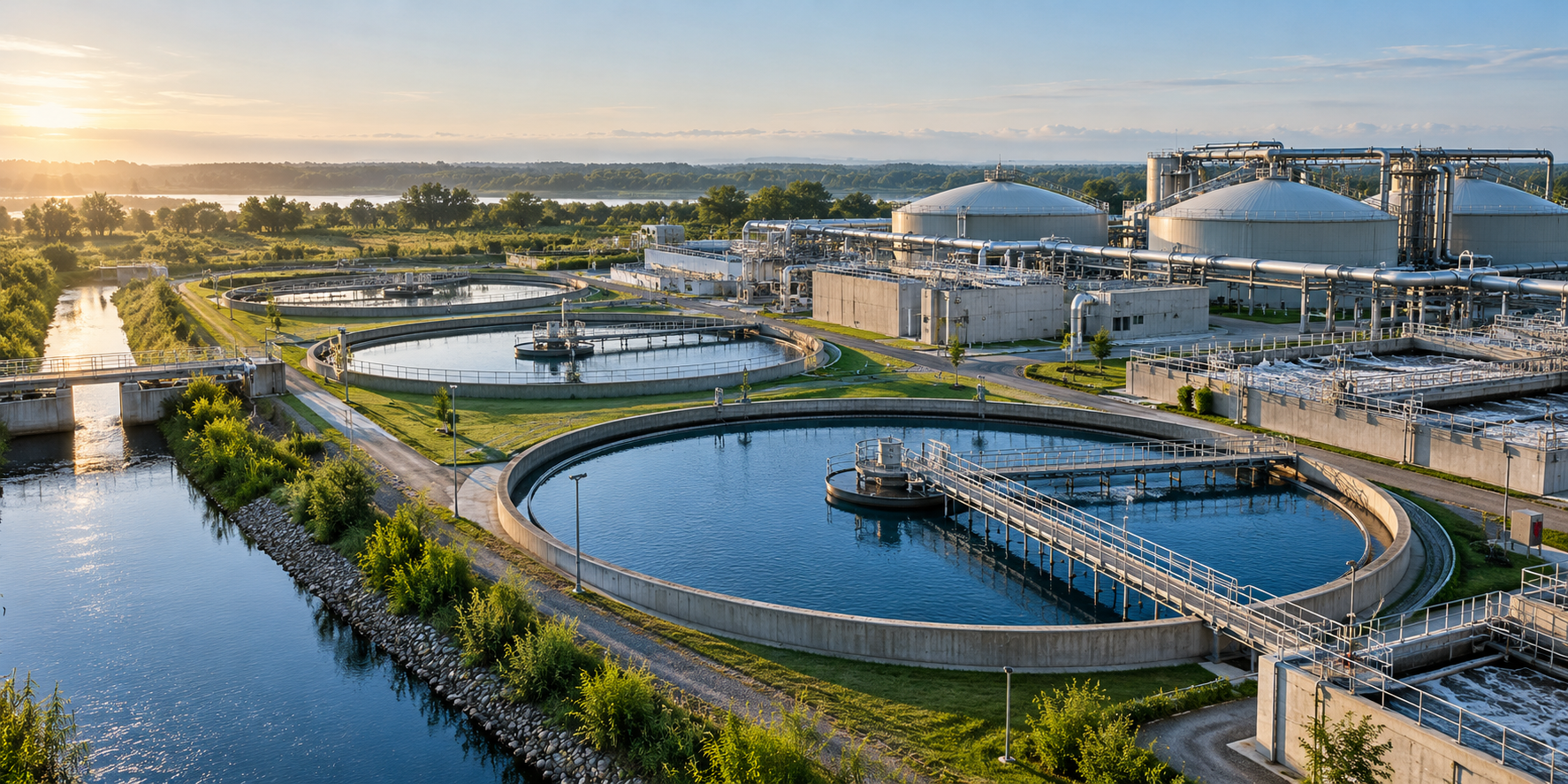
The wastewater market includes collection networks, pumping stations, storage, treatment works, sludge handling, discharge controls, monitoring equipment, reuse connections and digital systems. It also includes businesses that design, build, operate, maintain, finance or optimise those assets.
These segments have different economics. A treatment operator may carry energy, chemicals, labour and compliance risk. A component supplier may have product and warranty exposure. A project developer may carry planning, construction and commissioning risk before revenue begins. A monitoring provider may have a lighter asset base but still depend on installation, integration, data rights and customer action.
Market labels do not define investment risk
Two treatment assets can look similar while producing very different risk profiles. One may serve a diversified utility catchment with established funding. Another may rely on a single industrial customer, a new connection and a permit that is still being negotiated. The equipment may be comparable, but the contract, counterparty and cash conversion are not.
Investors should map each opportunity to its owner, operator, customer, permit, revenue mechanism and capital provider. This separates the underlying service need from the specific business model used to monetise it.
Why wastewater demand is becoming more visible
Regulation is creating work and scrutiny
The European Commission says the revised Urban Wastewater Treatment Directive entered into force on 1 January 2025. It extends expectations around treatment, nutrients, micropollutants, energy and monitoring. The Commission also identifies more than 30,000 urban wastewater treatment plants in the EU and estimates substantial annual benefits from the revised framework. For investors, this indicates a broad compliance and upgrade context, not an automatic margin.
The important diligence question is the path from obligation to purchase order. Identify the responsible utility or operator, the deadline, the technical standard, the procurement route, the funding source and the party bearing delay or performance risk.
Long-range plans expose capacity needs
In England and Wales, the GOV.UK drainage and wastewater management plan guidance sets a strategic planning framework with a minimum 25-year view. It considers current and future network capacity, climate pressures, population growth and other risks. A long planning horizon can improve visibility, but a plan is not the same as an approved project or a contracted revenue stream.
For a private business, the conversion test is practical. Which scheme has reached budget approval? Which supplier has a defined scope? Which work package has a procurement route? Which contract sets payment, indexation, delay, acceptance and renewal terms? These questions matter more than the existence of a national investment theme.
Pollution performance is becoming more data-led
The UK government report on water and sewerage company pollution incidents describes statutory pollution incident reduction plans from April 2026, long-range investment needs and the role of drainage and wastewater management plans. It also notes the scale of event-duration monitoring across England. More monitoring can support accountability and create demand for sensors, data systems, field services and treatment upgrades, but the value depends on data quality and the customer’s ability to act on it.
A monitoring company should therefore explain what happens after a reading is produced. Does the information trigger maintenance, a compliance response, a treatment adjustment or a capital decision? The commercial value is stronger when the workflow, responsible user and measurable outcome are clear.
How wastewater businesses make money
Capital projects and equipment
Design, engineering, construction and equipment businesses earn revenue around delivery. They may benefit from funded upgrades and repeat procurement, but revenue can be lumpy. Investors should test order quality, backlog conversion, procurement concentration, subcontractor exposure, warranty provisions, liquidated damages and the timing of milestone payments.
Operations, maintenance and performance services
Operations and maintenance contracts can provide recurring revenue, but recurrence does not remove operating risk. Staff, electricity, chemicals, laboratory work, sludge handling, spare parts and performance guarantees can all affect margin. Contract duration should be reviewed alongside renewal evidence, indexation and the customer’s ability to terminate.
Monitoring, optimisation and data
Digital and monitoring businesses may sell equipment, subscriptions, analytics, integration or managed services. The model can scale more efficiently than a physical asset base when installation and support are controlled. It can also become fragile if the product depends on bespoke integrations, uncertain data rights or a customer that collects data without changing operations.
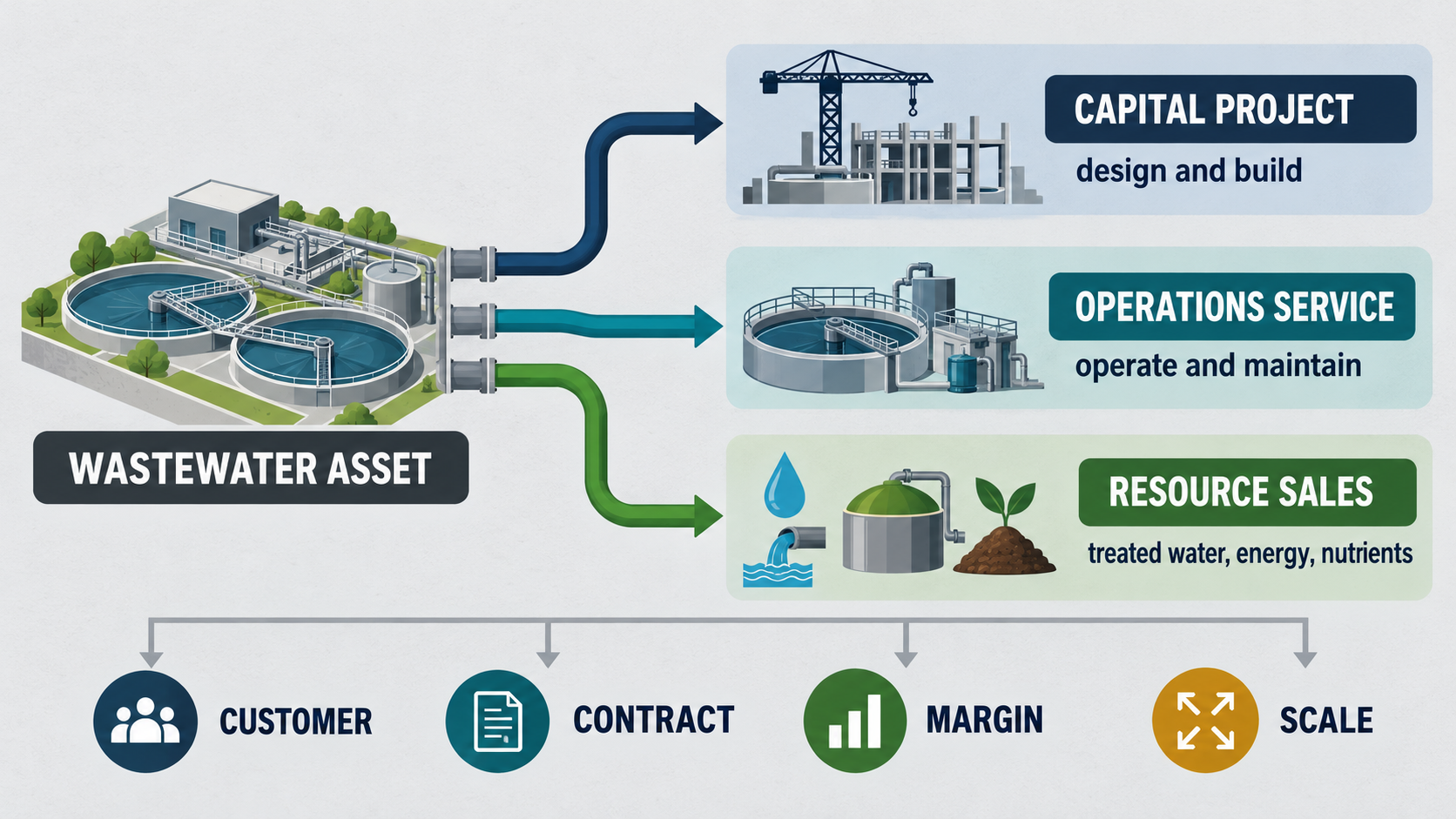
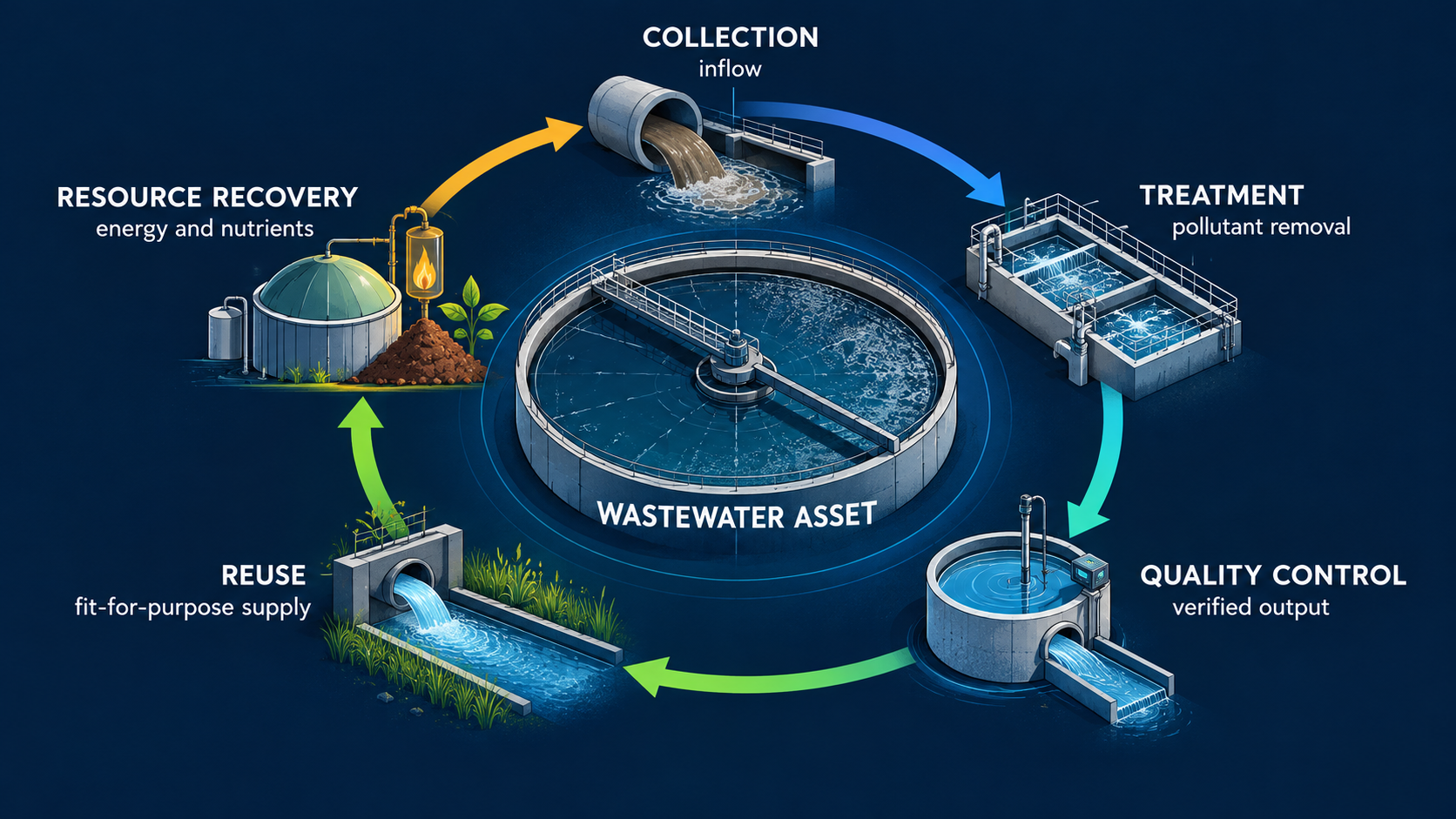
Resource recovery adds another route to revenue. Treated water, biogas, nutrients, heat or other recovered outputs may have value, but that value needs a buyer, specification, connection and price. A recovery concept should be assessed as a commercial contract, not only as an environmental benefit.
From market demand to operating cash flow
Separate the project pipeline from contracted revenue
A wastewater project usually moves from a defined need through feasibility, approvals, procurement, construction, commissioning and operation. Each gate can change scope, timing, capital requirements and risk allocation. A pipeline is only as valuable as its stage, funding and conversion evidence.
Investors should distinguish an expression of interest from a budgeted scheme, a signed contract and an operating asset. Review site control, design maturity, permit status, customer approval, financing, procurement route and expected commissioning date. Then model what happens if one gate slips.
Cash conversion can lag commercial traction
Businesses can show strong customer interest while consuming cash. Deposits, milestone payments, retention, inventory, subcontractor terms, work in progress and commissioning costs shape the funding need. Revenue growth without a delivery cash profile is incomplete analysis.
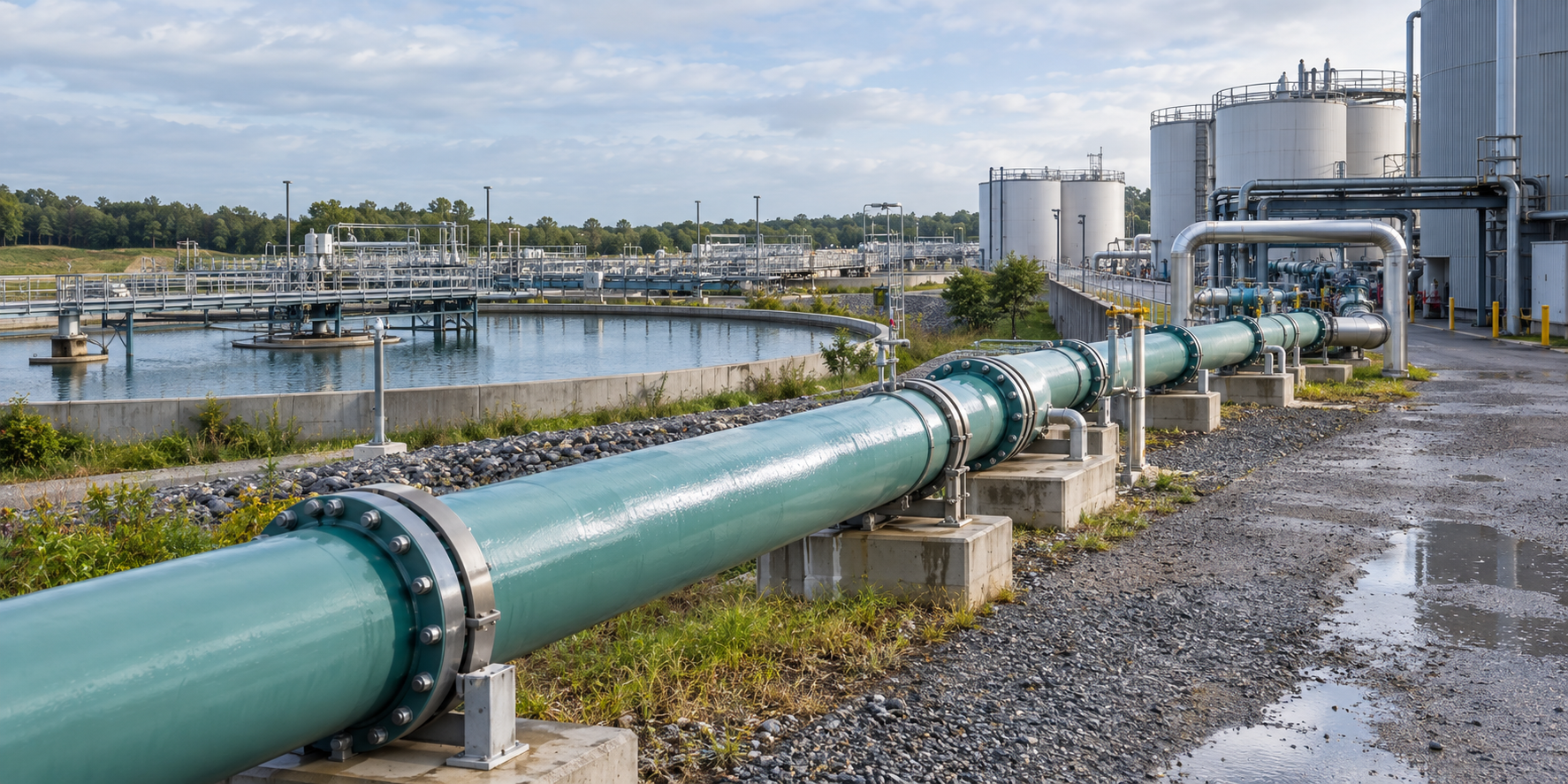
Reuse projects illustrate the point. A customer may need a reliable non-potable supply, but the project still needs treatment to the required quality, a connection, monitoring, an operating plan and a payment mechanism. Proximity between the treatment asset and the user can help, but it does not remove offtake, energy or compliance risk.
Contract mechanics shape the downside
Review the payer, term, indexation, renewal, termination, liability, acceptance and performance provisions. A long contract can be weak if payment depends on a grant, one offtaker or unresolved permit. A shorter contract can be attractive when the service is essential and renewal evidence is visible.
Model the point at which energy, labour or chemical costs rise faster than the contract price. If repricing is available, test the process, timing and customer consent. If performance penalties apply, quantify the operational conditions that could trigger them.
How reuse changes the value of wastewater
Wastewater can become a local supply input
Reuse changes the commercial question from disposal to supply. A treatment asset may provide water for an industrial park, manufacturing process, cooling system, municipal use or another defined application. The value comes from meeting a specified need with a reliable service, not from calling the output a resource.
Fit-for-purpose treatment means producing water to the quality required for its intended use. Higher quality can require more treatment, energy, monitoring and controls. Lower quality may be suitable for a non-potable application. The investment case depends on the customer specification and the cost and reliability of the alternative supply.
Bankability needs more than technical feasibility
The World Bank’s water programmes describe the need for integrated planning, appropriate delivery models and project preparation. Its WICER work also connects circular economy approaches with new revenue streams, lower operating costs and resilience. These ideas help an investor frame the opportunity, but they do not prove that a particular project has a bankable offtake.
Ask whether the offtaker is creditworthy, whether quality is defined and monitored, who pays for the connection, who carries volume and energy risk, and whether the model can repeat across a programme. A single successful demonstration may prove technical feasibility without proving commercial scale.
Resource recovery needs a route to market
The World Bank’s Scaling Water Reuse report frames reuse as a fit-for-purpose supply opportunity for cities and industries. It also stresses programme scale, clear pricing signals, enabling regulation and bankable delivery models. Investors should connect each recovered output to a buyer, quality standard, logistics plan and price. If that route is missing, recovery may remain an operating cost or an unmonetised benefit.
Where margins and scalability are won or lost
Standardisation reduces delivery friction
Scale may come from repeatable plant modules, standard contracts, a regional service network, a software layer or a portfolio of contracted assets. Each route has a different bottleneck. Manufacturing needs quality control and inventory. Services need local talent and response coverage. Digital systems need integrations and reliable data. Assets need capital and utilisation.
A business is not scalable merely because the wastewater market is large. Ask what must increase for revenue to grow, and whether that input can grow without the same increase in bespoke engineering, project management or working capital.
Margins need a physical explanation
In treatment operations, margins can move with electricity, chemicals, labour, sludge handling, maintenance and replacement parts. In construction, they can move with procurement, subcontractors, commissioning and variation orders. In monitoring, they can move with connectivity, installation, support and customer integration.
Technology risk can become financial risk. A system that underperforms may require additional treatment, redesign, compensation or replacement. Review warranties, acceptance tests, insurance and the evidence supporting each performance claim.
Defensibility is often operational
Defensibility may come from approvals, reference sites, operating data, integration knowledge, service coverage, specialist staff or a trusted position in a long procurement cycle. A patent can help, but it does not replace delivery capability. Investors should ask which advantage survives a customer tender and which advantage depends on one relationship.
Maintenance access is another scale constraint. Assets may need planned shutdowns, specialist parts, laboratory testing or trained operators. A company that relies on one supplier or one technical founder can have a fragile delivery model even when the installed equipment is sound.
UK, Europe and GCC: different routes to opportunity
UK demand is plan-led and scrutinised
UK opportunities can be shaped by regulated company plans, drainage and wastewater management planning, environmental requirements and public scrutiny. The government’s pollution report notes a £20 billion base expenditure allowance for the wastewater network in the 2025 to 2030 period. That figure is a planning and regulatory context, not a forecast of revenue for any individual supplier.
Investors should trace the route from plan to approved spend, procurement package, contract and operating performance. A business serving a funded workstream may still face competitive tenders, delivery penalties and working-capital pressure.
Europe adds harmonised direction with local execution
The revised EU Urban Wastewater Treatment Directive creates a common policy direction around treatment, nutrients, micropollutants, energy and monitoring. National implementation, utility structure, procurement and financing remain important. A supplier may have a transferable product, while its sales cycle, local approvals and service model remain country-specific.
The European Investment Bank expects global freshwater demand to exceed sustainable supply by 40% in 2030 and has set a water investment ambition for 2025 to 2027. That reinforces the scale of the underlying need, but investors still need transaction-level evidence.
GCC opportunity depends on the exact customer and jurisdiction
GCC demand can be linked to water security, reuse, industrial expansion, urban development and desalination. The region is not one market. Diligence should cover the exact jurisdiction, offtaker, energy profile, local partner, currency, import route, contractor structure, payment protection and service plan.
A technology may travel well while a permit pathway, operating model or service network does not. Cross-border investors should assess how the business will support the asset after commissioning and how political, currency and counterparty exposures are allocated.
Wastewater market diligence: five questions
1. Who pays and why now?
Verify the budget owner, procurement route, contract term, payment protections and alternative solutions. A public policy need becomes an investable opportunity only when the spending route is clear.
2. What approvals and performance standards apply?
Confirm permits, monitoring obligations, acceptance tests, warranties and the evidence behind performance claims. Separate a pilot result from a paid asset operating under contractual obligations.
3. What capital is required before cash arrives?
Model construction, connection, commissioning, working capital, debt, maintenance and renewal. Include retention, delays, cost escalation and the timing of customer acceptance.
4. What can repeat and what remains bespoke?
Map the work required for each new deployment. Test whether the business can repeat its design, delivery, commissioning and service model without the same increase in headcount and working capital.
5. Can outcomes be verified without overclaiming?
Review discharge data, reuse volumes, energy use, incidents, safety, data rights and customer reporting. Governance is part of infrastructure quality because failures can create fines, delays, remediation costs or lost contracts.
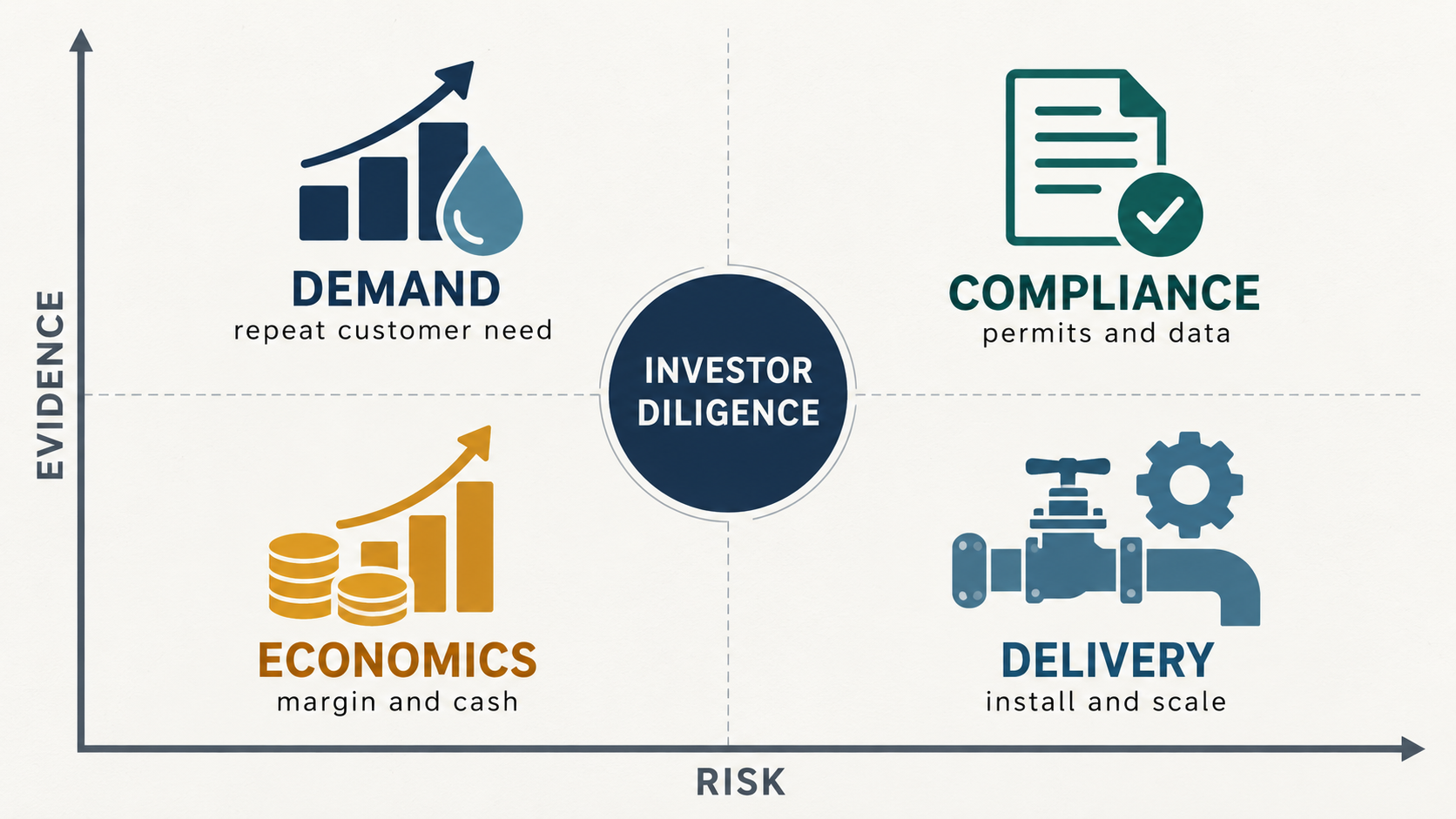
The strongest opportunities make these answers easy to verify. They show a defined asset or service, a credible customer, an approved route to operation, transparent economics and a practical plan for repeat deployment.
Frequently asked questions
What is the wastewater market?
The wastewater market includes the assets, services, technologies and projects used to collect, treat, monitor, reuse and manage used water. Investment risk depends on the specific customer, contract, permit, operator and capital structure.
Why can the wastewater market attract private capital?
It can address funded needs linked to compliance, capacity, pollution control, resilience, industrial continuity and reuse. Private capital still requires a clear payer, delivery route, performance evidence and risk allocation.
Is the wastewater market defensive?
Some assets may benefit from essential demand or long contracts, but no label removes construction, regulatory, technology, energy, counterparty or renewal risk. Each opportunity needs its own diligence.
How does reuse affect the wastewater investment case?
Reuse can turn treated wastewater into a local supply for a defined customer. The case depends on fit-for-purpose quality, an offtaker, connection costs, regulation, energy use and a bankable contract.
What should investors review first?
Start with the customer, contract, permit and operating evidence. Then test capital needs, margins, cash conversion, scalability, governance and measurable impact.
Explore direct water-technology opportunities
The wastewater market can support durable commercial activity, but the investable case is specific. It rests on a defined asset or service, a funded customer need, credible delivery evidence and economics that remain workable through operation and renewal.
Water Investment Network helps eligible investors review direct water-technology opportunities with a focus on commercial fit, evidence and execution risk. Explore the water-technology portfolio, read the water market investment thesis, or contact the network with a specific question.
If you are assessing opportunities aligned with this market, join the network to discuss the next step. This is an introduction to private opportunities, not a recommendation or regulated advice.
Sources
- European Commission, Urban wastewater.
- GOV.UK, Drainage and wastewater management plans: guiding principles for the water industry.
- European Investment Bank, Water and waste water management.
- GOV.UK, Water and sewerage companies in England pollution incident report for 2016 to 2024.
- World Bank, Water for People and WICER.
- World Bank, Scaling Water Reuse: A Tipping Point for Municipal and Industrial Use.