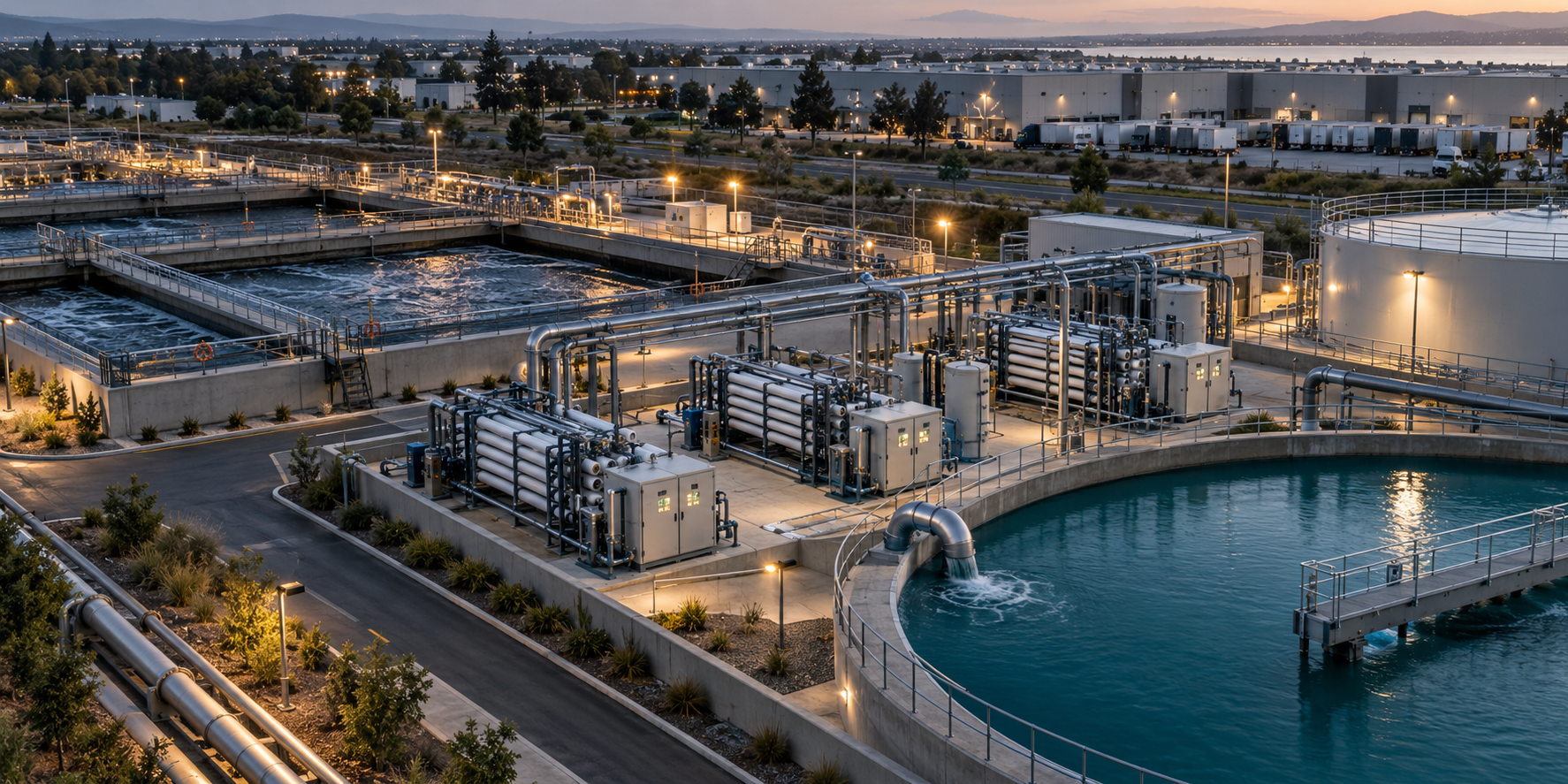
The water industry is moving up the private-investment agenda because water is no longer only a utility cost. For industrial operators, property owners and public authorities, reliable water supply, treatment and discharge are operating requirements. A business that reduces water risk can therefore create value through continuity, compliance, capacity or measurable operating efficiency.
That does not make every water company investable. The commercial question is whether a product or asset solves a funded customer problem, performs in the field and converts delivery into repeatable cash flow. This market outlook examines the water industry through that investor lens, with attention to the UK, Europe and the Gulf Cooperation Council (GCC).
The discussion is educational and does not provide regulated financial advice or promise returns. Investors should assess each opportunity, its documents, its jurisdiction and its risks independently.
Why water industry investment is growing
Demand is becoming more operational
Water demand is shaped by population, industry, food production, construction and climate exposure. For an investor, the useful signal is not a large global headline by itself. It is the point at which a water constraint affects production, site expansion, insurance, permitting or the cost of an alternative supply.
The European Commission says global water demand could exceed available resources by 40% by 2030. Its water resilience strategy also identifies water efficiency, infrastructure renewal, digitalisation and innovation as areas for action. These priorities can create investable demand when they are translated into a budget, a procurement process and a measurable performance requirement.
Capital has to meet bankable projects
The World Bank’s summary of a joint multilateral development bank report says the MDBs approved $19.6 billion of water-related financing in 2024, including $14.4 billion for low- and middle-income economies. That is evidence of continuing capital mobilisation, but it is not a forecast for a particular private company. It also reinforces an important diligence point: water opportunities often depend on the structure around an asset, not only on the technology inside it.
The European Investment Bank makes a similar distinction in its work on future-proofing European water systems. The obstacle may be how investments are originated, coordinated, funded and financed. Investors should therefore ask who owns the problem, who approves the spend, who takes performance risk and who receives the cash flow.
What the water industry includes
A connected value chain
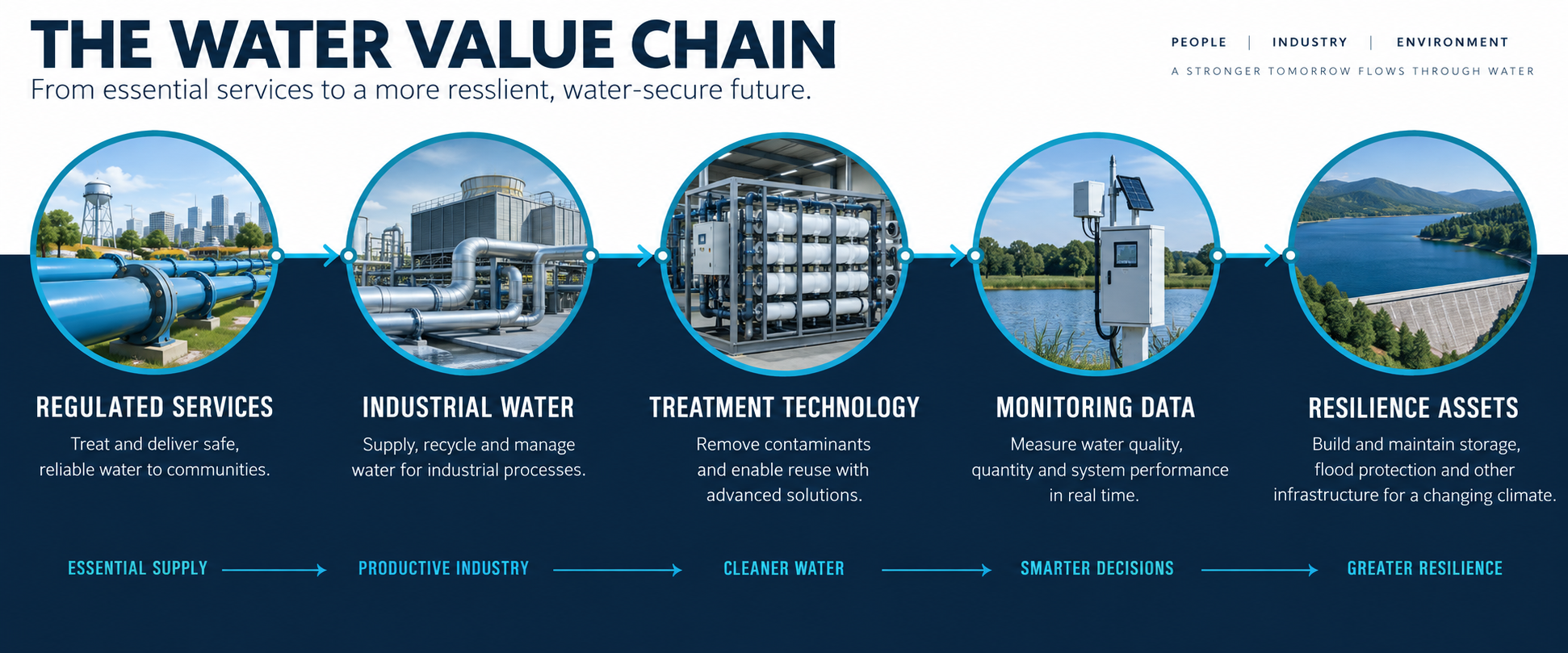
The water industry includes regulated supply and wastewater services, industrial water systems, treatment equipment, reuse infrastructure, monitoring, data and specialist services. These segments share a physical resource, but their customers, contracts and capital needs differ materially.
Regulated services may have long asset lives and formal oversight. Industrial water businesses may sell continuity, process quality or discharge compliance to a site owner. Technology providers may sell equipment, service, data or a performance outcome. A water asset owner may earn a capacity or treatment fee over a longer operating period.
Why the category boundary matters
Category labels can hide different risks. A membrane supplier has manufacturing, warranty and replacement exposure. A monitoring business has data quality, integration and retention exposure. A treatment operator has energy, maintenance, permitting and service-level exposure. An asset platform may have construction, financing, utilisation and counterparty exposure.
For private investors, the first task is to map the business to its actual value chain position. That prevents a broad water narrative from substituting for a clear view of the paying customer and the obligation the company has accepted.
Where paying-customer demand comes from
Compliance and permission to operate
Water quality, abstraction, discharge and environmental requirements can turn water management into a non-discretionary operating line. The strength of that demand depends on the applicable rules, the enforcement environment and the cost of non-compliance. A diligence process should verify the exact obligation rather than relying on a general statement that regulation is tightening.
Continuity, capacity and cost control
A manufacturer may need consistent process water. A data centre or logistics site may need resilient supply and discharge capacity. A food or beverage producer may need treatment that protects product quality. A property developer may need water infrastructure before a site can be occupied. In each case, the commercial value is linked to an operating consequence.
Other demand can come from water reuse, leakage reduction, energy optimisation and better measurement. The investor should test whether the customer pays for a saving, a risk reduction, additional capacity or a required service. Those are different value propositions with different evidence requirements.
Budget ownership is the practical test
Market enthusiasm does not pay an invoice. Identify the budget owner, procurement route, approval threshold and replacement cycle. Then ask whether the customer can buy directly, needs a regulated intermediary or requires project finance. This is often more informative than the size of the addressable market.
Timing matters as well. A customer may recognise a water risk but defer the project until a permit, expansion, outage or renewal creates a decision point. That delay affects sales-cycle length and the cash required to support the pipeline. Review the conversion path from identified need to approved scope, signed contract and paid deployment.
It is also useful to distinguish compliance spending from discretionary improvement. A mandatory upgrade may have stronger urgency, but it can carry procurement and price pressure. A discretionary efficiency project may offer more room for value-based pricing, but it needs a clear payback or risk-reduction case. The distinction should appear in the sales plan and the financial model.
How water-industry businesses make money
Four common commercial models
Water businesses can combine models, but the distinction is useful. Equipment revenue may arrive around a project and carry installation or warranty obligations. Service revenue may recur through operations and maintenance. Data revenue may depend on monitoring, software, integration and customer retention. Asset revenue may depend on capacity, treatment volumes, availability and contract performance.
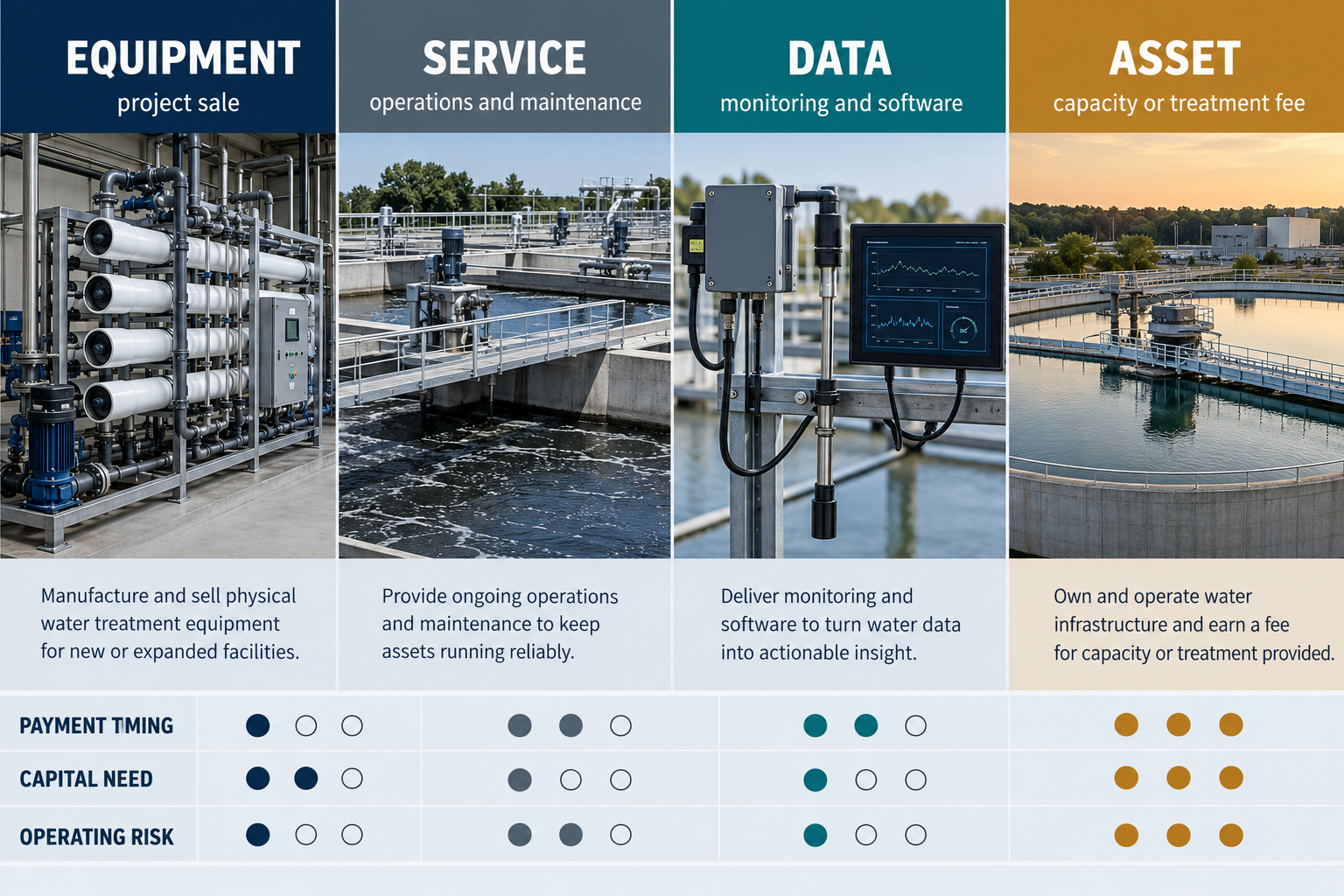
Recurring revenue is not automatically higher quality. A service contract can be difficult to deliver, while a well-priced equipment sale can be attractive if working capital and warranty obligations are understood. The relevant questions are contract durability, gross margin, cash conversion, reinvestment and the risk transferred to the supplier.
Revenue quality questions
- Who is legally responsible for payment, and what happens after a site underperforms?
- Is revenue linked to equipment shipped, service availability, measured output or customer savings?
- How much working capital is required before cash is collected?
- Which costs move with throughput, energy, chemicals, labour or replacement parts?
- Can the commercial model repeat without adding the same level of bespoke engineering each time?
These questions connect a headline revenue model to the economics an investor can actually underwrite. They also expose where a business is carrying project risk while presenting itself as a recurring platform.
Customer concentration deserves separate attention. A small number of large sites can accelerate reference-building and revenue, but the loss or delay of one project may change the whole forecast. Review renewal dates, procurement dependencies, payment history and the degree to which a relationship belongs to the company rather than to one founder, integrator or sales contact.
Pricing should be tested against the customer’s alternative. That alternative might be a conventional treatment system, an internal maintenance team, a different water source, a production change or simply accepting the existing risk. A solution with clear technical benefits may still struggle if the customer cannot recover the cost or if the purchase decision sits outside the team that experiences the problem.
From customer need to repeatable revenue
Start with a specific site problem
A credible water-industry sale normally starts with a site, a process, a requirement or a risk. The customer may need an approved discharge, additional capacity, lower water intensity or a system that keeps production within specification. The company must show how its offer is selected against alternatives.
That selection may involve a technical specification, a demonstration, a tender, a framework or a direct negotiated contract. The commercial evidence should show who made the decision and what the customer accepted. A logo list without that context is weak proof.
Delivery proof creates the bridge to repeatability
After a contract is signed, the value proposition becomes operational. Does the system meet its output requirement? Is the service available when required? Are maintenance and consumables predictable? Does the customer renew, expand or refer the solution to another site?
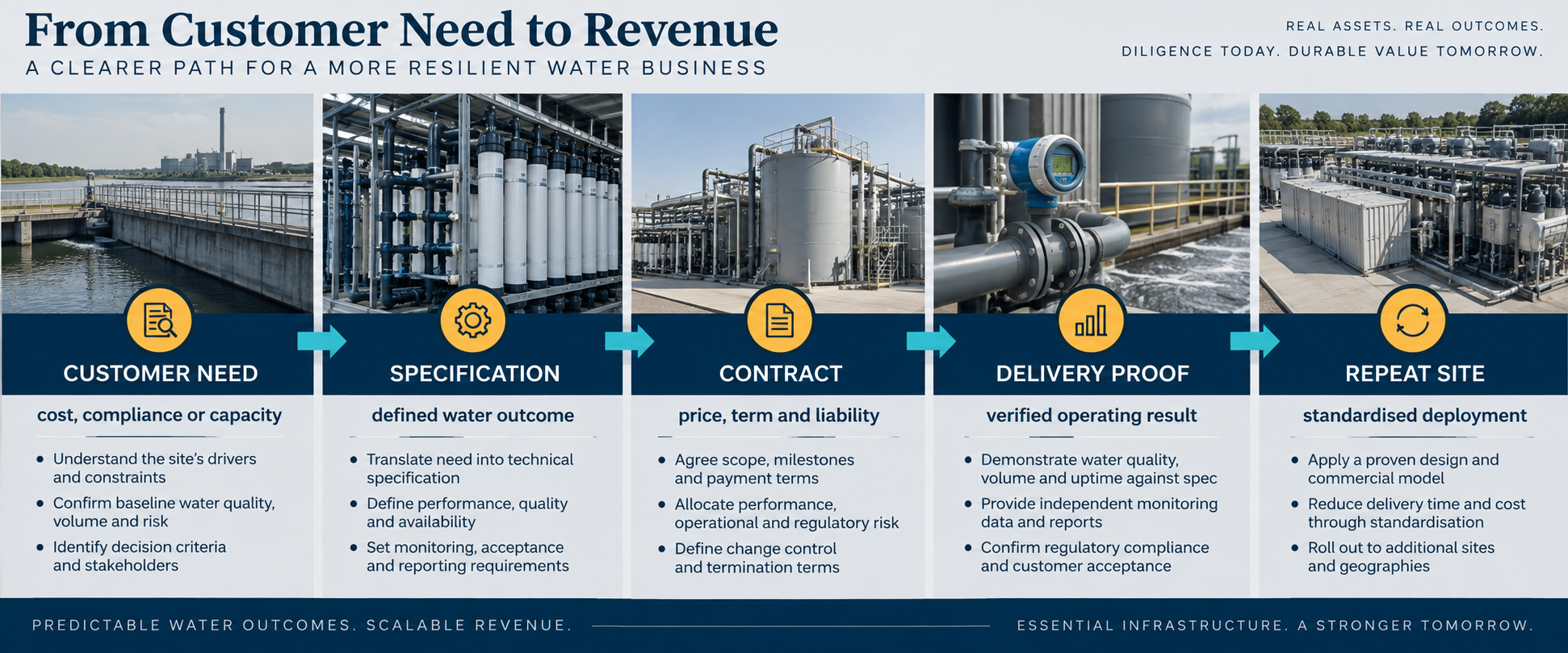
Repeatability is not simply selling the same product twice. It may mean a standardised design, a repeatable installation process, a dependable partner network or a data layer that can be deployed across sites. The more bespoke the delivery, the more carefully the investor should model engineering time, working capital and implementation risk.
Evidence should follow the same path. A strong reference explains the original requirement, the contracted scope, the commissioning point, the measured result and the current operating status. It may also show what was learned and standardised for the next deployment. This is more useful than a case study that reports only an installation date or a broad environmental benefit.
How technology becomes commercially adoptable
Explain the technical term through its customer effect
Membrane treatment separates substances through a selective barrier. In commercial terms, that can change water quality, reuse potential, energy use, maintenance and the treatment train required at a site. Sensors measure a condition or process variable. Their value depends on accuracy, integration, operator response and the cost of acting on the information.
Digital water tools can improve visibility, but a dashboard is not a business model. The investor should trace the chain from measurement to decision to operating outcome. If the customer cannot change a process, document compliance or avoid a costly event, data may not convert into durable willingness to pay.
Adoption depends on the operating environment
Technology must fit existing infrastructure, procurement rules, maintenance capability and risk tolerance. A technically impressive solution may fail if installation interrupts production, requires unavailable skills or creates an approval burden. A smaller performance improvement may win if it is easy to specify, finance, install and verify.
Commercial adoption can be supported by validation at relevant sites, warranties that match the contract, service capacity and clear responsibility for performance. Investors should separate laboratory results, pilot evidence and paid operating references. Each answers a different question.
Integration risk is often underestimated. A new treatment or monitoring layer may need access to existing controls, laboratories, maintenance records, data systems or site operators. The integration plan should identify the interfaces, the party responsible for each one and the fallback if the promised output is not achieved. These details can determine whether a pilot becomes a repeat order.
How to judge scalability, margins and capital needs
Scalability is more than market size
Scale can come from manufacturing volume, a repeatable service territory, a software deployment, a portfolio of contracted assets or a network of delivery partners. Each route has a different bottleneck. Manufacturing may need quality control and inventory. Services may need people close to the customer. Software may need integrations and retention. Assets may need long-dated capital and reliable utilisation.
Ask what must grow for revenue to grow. If every new contract requires a new bespoke team, the operating model may scale more slowly than the sales narrative suggests. If the model is asset-heavy, examine funding, construction, commissioning and refinancing risk separately from customer demand.
Margins need an operating explanation
Gross margin should be connected to the work performed. In equipment, consider materials, installation and warranty. In services, consider labour, energy, chemicals and travel. In data, consider connectivity, hosting, support and integration. In asset models, consider operations, maintenance, debt service and planned reinvestment.
Cash conversion matters because water projects can have long approval, build and payment cycles. A business can report growth while consuming cash through receivables, inventory or project work in progress. Review contract milestones, deposits, retention, change orders and customer concentration.
Capital intensity should be viewed across the full lifecycle. Initial equipment is only one requirement. Expansion may require testing facilities, spare parts, commissioning teams, local certifications, software support or working capital for larger contracts. An investor should ask whether growth is funded by customer deposits, operating cash flow, external debt or new equity, and whether that funding remains available if deployment takes longer than planned.
How UK, Europe and GCC markets differ
UK and European policy signals
The UK government’s 2026 water white paper describes a £104 billion programme for 2025 to 2030 and sets out reforms intended to attract investment, support long-term planning and improve regulatory stability. That is a policy direction, not a promise of revenue to any business. Investors should still identify the procurement channel, regulated entity and funding decision behind each opportunity.
The European Commission’s strategy places water efficiency, infrastructure, digitalisation and innovation in a broader resilience framework. The EIB also describes substantial investment needs while highlighting the importance of project origination and coordination. These signals can support market formation, but execution remains local and asset-specific.
GCC opportunities require local diligence
In GCC markets, water security, desalination, reuse, industrial development and urban expansion can create significant demand. The investment case still depends on the specific jurisdiction, offtaker, tariff or service agreement, energy profile, contractor structure and payment protections. Do not treat the GCC as one market or assume that a public priority guarantees private cash flow.
For a cross-border investor, compare contract law, currency, import requirements, local partners, political and counterparty risk, and the practical availability of operations talent. A technology that is attractive in one market may require a different commercial partner or treatment configuration in another.
Comparability also matters. Reported market size, treatment capacity and tariff structures may use different definitions across jurisdictions. Before comparing opportunities, normalise the unit of sale, contract duration, customer type, currency exposure and performance obligation. This makes a smaller but better evidenced opportunity easier to compare with a larger project that depends on more assumptions.
Water industry diligence: five questions
Customer and performance
First, who pays and why now? Confirm the customer’s operational problem, budget owner and alternative options. Second, what evidence shows performance at operating sites? Separate measured outcomes from demonstrations, and confirm who measured them.
Contract and economics
Third, what do contract term, renewal, service levels, warranties and termination rights require? A long contract with difficult obligations may not be lower risk than a shorter contract. Fourth, how do margin and cash conversion behave as the business grows? Model energy, labour, chemicals, working capital, maintenance and capital expenditure rather than using a generic margin assumption.
Scale and governance
Fifth, what can repeat across sites, and what remains bespoke? Then test governance around safety, permitting, data, environmental claims and customer reporting. The European Investment Bank’s water and wastewater programme illustrates why infrastructure priorities still need a financeable delivery route. That is a useful reminder to examine incentives and risk allocation alongside the technology.
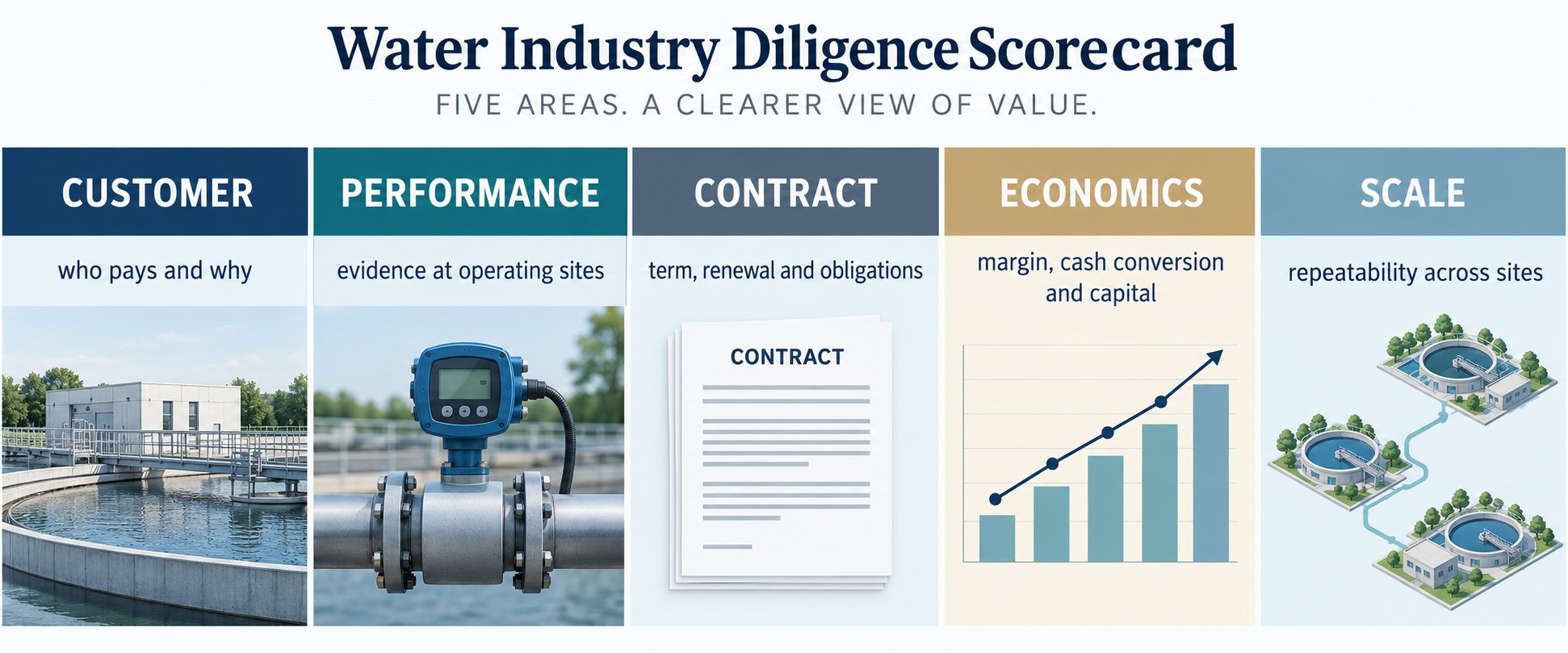
The strongest opportunities make these answers easier to verify. They show a defined customer, a relevant operating record, a contract that matches the promised service, transparent economics and a credible route to repeat deployment.
Governance should sit inside that review, not after it. Check ownership of permits, environmental reporting, health and safety, cyber controls for connected assets, data rights and claims made to customers. In a regulated or infrastructure-linked market, weak governance can delay deployment, increase liabilities or reduce the value of otherwise sound technology.
Frequently asked questions
What is the water industry?
The water industry covers businesses and assets involved in water supply, wastewater, industrial water, treatment, reuse, monitoring, data and related services. The commercial model and risk profile depend on the exact position in that value chain.
Why can water be an investment theme?
Water is linked to essential operations, regulation, resilience and infrastructure renewal. An investment thesis becomes more credible when it identifies a paying customer, a funded need and evidence that the solution performs in the relevant operating environment.
Are water-industry businesses defensive?
Some water services may have durable demand, but no label removes execution, regulatory, counterparty, technology, energy or capital risk. The contract, asset and customer must be analysed on their own terms.
How should investors compare water technologies?
Compare the customer problem, measured performance, adoption friction, lifecycle cost, service obligations, replacement cycle and ability to repeat across sites. A technical feature matters only when it changes a customer outcome and the economics support adoption.
What should a private investor review first?
Begin with the customer and contract, then verify operating evidence, unit economics, capital needs, regulation and governance. The sequence helps prevent a broad market narrative from replacing evidence about a particular opportunity.
Explore direct water-technology opportunities
The water industry is broad enough to support different private-market strategies, from treatment equipment and monitoring to operating services and infrastructure. It is also specific enough to require disciplined diligence. The key question is not whether water matters. It is whether a defined business can solve a defined customer problem, earn an appropriate commercial return for the risk it carries and expand without losing control of delivery.
Water Investment Network helps investors review direct water-technology opportunities with a focus on commercial fit, evidence and execution risk. Explore the water-technology portfolio, review the water market investment thesis, or contact the network with a specific diligence question.
If you are assessing opportunities aligned with this market, join the network to discuss the next step. This is an introduction to private opportunities, not a recommendation or regulated advice.